


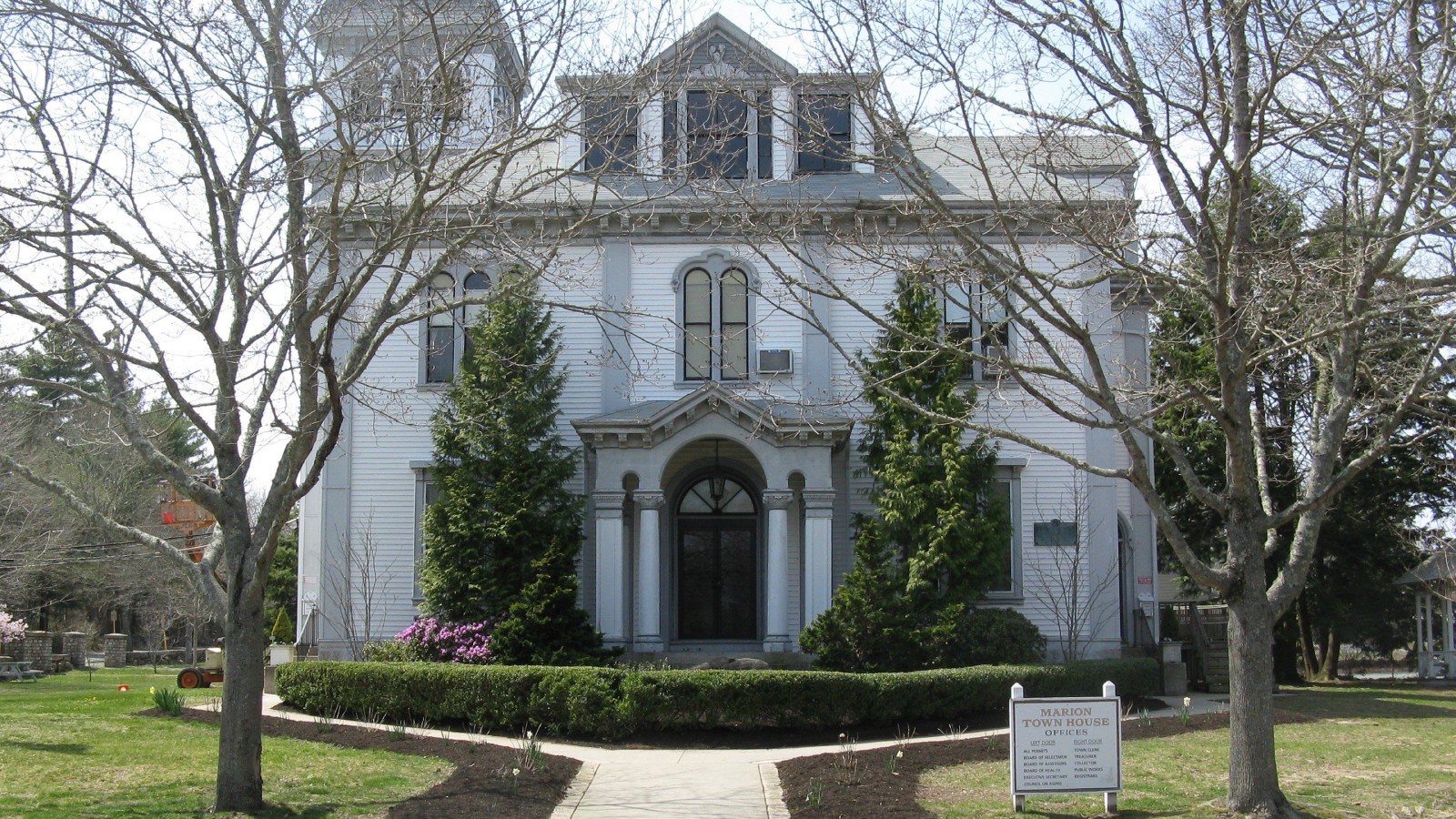

MARION Marion's Select Board and Board of Assessors will hold the town's tax classification hearing Tuesday, Nov. 3, at 6 p.m. in the Town House conference room, 2 Spring St. The Select Board uses the hearing to decide how Marion's property tax levy is shared among homes, businesses and other kinds of property, a step that comes before the town's fiscal 2027 tax rate is set.
Marion does not yet have a fiscal 2027 tax rate on the state's books. The classification choice decides whether homeowners keep paying the same rate as business owners, or pay a lower rate while commercial, industrial and personal property owners pay a higher one.
What Marion pays now
In fiscal 2026, Marion taxed every class of property at the same rate, $8.87 per $1,000 of assessed value. That was down from $9.32 in fiscal 2025 and the lowest rate the town has had since fiscal 2010, when it was $8.55, according to the state Division of Local Services. Marion has taxed every class at one rate in every year since at least fiscal 2008.
The lower rate did not bring a smaller bill. The average single-family home in Marion was valued at $1,004,280 in fiscal 2026, up 7.2% from $936,973 the year before, state figures show. The average single-family tax bill rose $175, or 2%, to $8,908.
That was the highest average single-family bill among the 19 South Coast cities and towns, ahead of Mattapoisett at $8,244. The town had 2,280 single-family parcels on its tax rolls.
What the board decides
State law requires the select board of a town certified as assessing property at full and fair cash value to decide each year what share of the tax levy each class of property will carry, and to adopt a residential factor first. The residential factor cannot go below a minimum set by the state revenue commissioner. In Marion, the Select Board makes that choice in a hearing held jointly with the assessors.
The law requires a public hearing before the board adopts the percentages, and at that hearing the assessors must give the board the information and data relevant to the decision and the fiscal effect of each alternative. Residents can hear those figures at the Town House or on ORCTV.
Neighboring Mattapoisett ($10.24), Rochester ($10.59) and Wareham ($8.56) also used one rate in fiscal 2026. Acushnet, Dartmouth and Fairhaven split theirs: Dartmouth taxed homes at $8.03 and commercial and industrial property at $15.78.
For how average bills changed across the region last year, see our town-by-town look at fiscal 2026 tax bills.
Also on the agenda
After the hearing, the board takes up guidance for the fiscal 2028 budget, a Select Board letter to owners of property whose fiscal 2024 taxes are still delinquent, and an update on delinquent water accounts.
The board, which also meets as the town's water and sewer commissioners, will weigh two water and sewer abatement requests and a request for a new sewer connection, and it is set to discuss, and possibly vote on, a pavement moratorium policy on its second read. The board will also discuss alternatives for a shared use path on Point Road.
The finance director is scheduled to present the town's fiscal 2026 report on other post-employment benefits, the retiree benefits other than pensions that the town has promised its workers, along with an update on the Waterways Working Group. The town administrator's report includes a pavement and sidewalk project upgrade.
How to attend or watch
The meeting is open to the public at the Town House, and ORCTV will record and televise it.
Label: Reported by us, from the town's posted records.
Notes
Every fact comes from the Town of Marion's own Nov. 3 agenda and hearing notice, received by the town clerk Oct. 30, the state Division of Local Services' tax rate and average bill reports, and Mass. General Laws c. 40, s. 56, read Oct. 31. We recomputed the 7.2% value rise, the $175 and 2% bill rise, and the $8,908 bill from the $8.87 rate. We checked each date and weekday against a calendar: Nov. 3, 2026 is a Tuesday.
Corrections
No corrections to this story. If something here is wrong, tell us. Every correction is dated on the story and listed in our public log.
Sources (4)
- Marion Select Board and Water/Sewer Commissioners meeting agenda, Tue. Nov. 3, 2026, 6 p.m. (received by the town clerk Oct. 30, 2026, 1:20 p.m.)Town of Marion. Public hearing by the Select Board and Board of Assessors at the Town House Conference Room, 2 Spring Street, Nov. 3, 2026, 6 p.m., "for the purpose of determining the classification of real property"; discussion items include Fiscal Year 2028 Budget Guidance, a letter to delinquent Fiscal Year 2024 property tax accounts, the pavement moratorium policy second read, two water/sewer abatements, a sewer connection, Point Road shared use path alternatives and a delinquent water account update; finance director FY2026 OPEB report; recorded and televised by ORCTV. Read Oct. 31, 2026.
- Massachusetts Division of Local Services: Tax Rates by Class (read Oct. 31, 2026)Mass. DOR Division of Local Services. FY2026: Marion 8.87 residential, commercial, industrial and personal property; Mattapoisett 10.24; Rochester 10.59; Wareham 8.56 (single rates); Acushnet 10.45/14.73, Dartmouth 8.03 residential, 15.78 commercial and industrial, 15.73 personal property, Fairhaven 9.19/18.20 (split). Marion single rate every year FY2008 to FY2026; FY2025 9.32, FY2011 9.40, FY2010 8.55, nothing lower since FY2010. No FY2027 rate listed for Marion. Read Oct. 31, 2026.
- Massachusetts Division of Local Services: Average Single Family Tax Bill (read Oct. 31, 2026)Mass. DOR Division of Local Services. Marion FY2026: 2,280 single-family parcels, average value $1,004,280, average bill $8,908; FY2025: average value $936,973, average bill $8,733. Mattapoisett FY2026 average bill $8,244, the next highest of the 19 South Coast communities (Acushnet, Berkley, Dartmouth, Dighton, Fairhaven, Fall River, Freetown, Lakeville, Marion, Mattapoisett, New Bedford, Rehoboth, Rochester, Seekonk, Somerset, Swansea, Taunton, Wareham, Westport). Read Oct. 31, 2026.
- Mass. General Laws c. 40, s. 56 (percentages of local tax levy by class of property)Massachusetts Legislature. The selectmen of each town certified as assessing at full and fair cash valuation "shall annually first determine the percentages of the local tax levy to be borne by each class of real property ... and personal property" and "shall first adopt a residential factor." Read Oct. 31, 2026.