




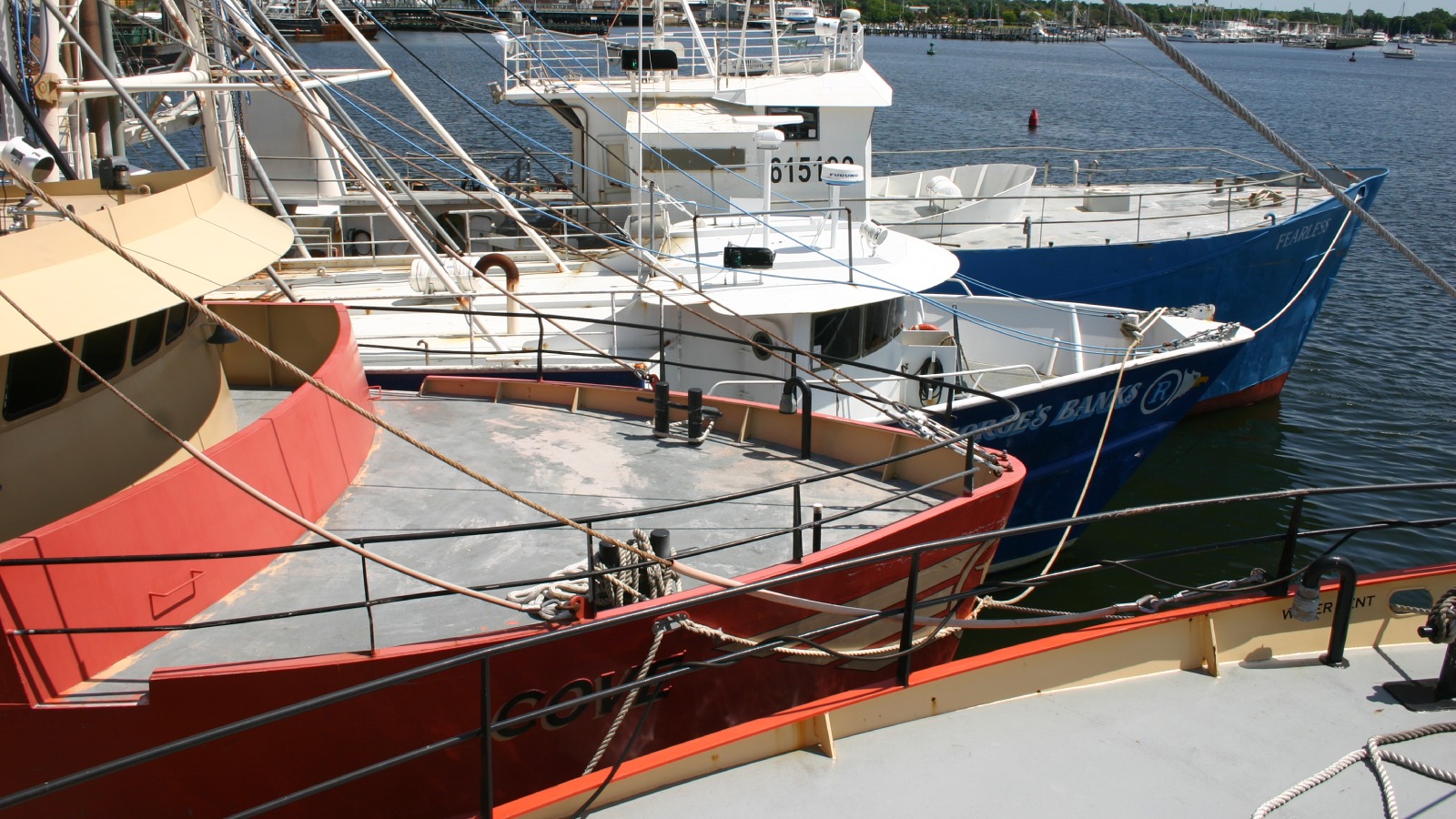

NEW BEDFORD The scallop fleet that anchors New Bedford's waterfront will learn the shape of its 2027 season over the next month, starting Tuesday, when a regional council panel recommends its choice among options that council staff value at $275 million to $439 million at the dock.
Those dollar figures are the New England Fishery Management Council staff's estimates of total scallop revenue in 2027, in 2025 dollars, for options that would land from 15.5 million to about 25 million pounds of scallop meat. The council's Joint Scallop Committee and Advisory Panel meets at 9 a.m. Tuesday, Nov. 17, at the Hilton Garden Inn Boston Logan, with a webinar option. The panel is expected to recommend its preferred options that day, and the full council is set to take final action Dec. 9, according to the committee chair's memo and the staff presentation. That vote comes during the council's Dec. 8 to 10 meeting in Newport, R.I., the Nov. 5 Plan Development Team summary says.
New Bedford, which NOAA Fisheries ranks first in the nation by the value of its catch for the 24th year in a row, "driven primarily by the sea scallop fishery," has the most riding on the choice. The council's survey slide says scallop biomass is "hovering near 25 year low," and the decision document says the stock is below its target level, though it is not overfished and overfishing is not occurring.
Days at sea or one trip to Nantucket Lightship
The decision document gives the panel a matrix. A full-time boat could get 32 to 42 days of fishing in the open areas, and the council could add one trip of 9,000, 12,000 or 15,000 pounds into a reopened Nantucket Lightship access area, or keep that area closed. Closed Area II and the Nantucket Lightship Extension stay closed under every option.
This year a full-time boat got 36 open-area days and no access area trips under Framework 40, NOAA's rule published March 27, which projected 18.7 million pounds of landings for the 2026 season. Keeping 36 days with no access area trip in 2027 would land about 18.7 million pounds, worth $331.7 million, council staff projected.
If nothing is adopted in time, a fallback written into Framework 40 takes effect: 27 days for a full-time boat, 75% of this year's 36, with Area II and the Nantucket Lightship closed. Staff projected that fallback would land 15.5 million pounds, worth $274.6 million, about $57 million less than keeping this year's 36 days.
| Option for a full-time boat | Landings (million lb) | Revenue ($ million) | Change from 36 days, no trip ($ million) |
|---|---|---|---|
| 27 days, no access area trip (fallback) | 15.54 | 274.63 | minus 57.09 |
| 36 days, no access area trip (this year's days) | 18.73 | 331.72 | 0 |
| 32 days, one 15,000 lb Nantucket Lightship trip | 22.12 | 386.26 | 54.54 |
| 36 days, one 12,000 lb trip | 22.55 | 392.94 | 61.22 |
| 40 days, one 9,000 lb trip | 22.84 | 397.29 | 65.57 |
| 42 days, one 15,000 lb trip | 25.33 | 438.81 | 107.09 |
The staff's projection summary puts the 42-day option at 24.82 million pounds, lower than the 25.33 million pounds in its economic table, which the table above follows.
Why the Lightship divides the experts
Roughly half of all scallops across the resource sit in the Nantucket Lightship South and Extension areas, the staff presentation says, and that group of scallops is slow growing. The council's Scallop Plan Development Team, its scientific and technical staff, could not agree on Nov. 5 and sent two options forward: 36 days with no access area trip, or 32 days with one 12,000-pound Lightship trip.
Many on the team preferred keeping the area closed another year, according to the decision document. They said much of the biomass is still small and slow growing, that discards and handling deaths of the thin-shelled scallops could be substantial if the area opens early, and that waiting may maximize future yield and keep an access area available until young scallops in Area II grow to size, likely no sooner than the 2029 fishing year. One member raised a concern that dredging on the area's fine-sediment bottom could smother scallops.
Others backed a limited opening with a small trip limit, a delayed opening or seasonal closure, and the Extension kept closed. The area holds a substantial amount of exploitable scallops, the allocations under consideration would take only a small part of them, and delaying harvest carries its own risks given uncertainty about future natural deaths and resource conditions, the document says. The staff presentation adds that keeping the area closed may risk more scallop deaths from sea stars, which 2026 surveys found in rising numbers.
At the Nov. 5 meeting, committee member Eric Hansen recommended a May 15 opening and an Oct. 1 to Jan. 1 closure, which "would help stabilize market price, spread out harvest, reduce incidental mortality," the meeting summary says. John Quinn of the Fisheries Survival Fund disagreed with deciding an access area trip together with the open-area days, and committee member Kirby Aarsheim asked why 38 days was not analyzed, according to the summary.
Seasons, small boats and the Gulf of Maine
If the Lightship opens, the team recommends a delayed opening on May 15, 2027, for the first year only, and a closure every Oct. 1 through Dec. 31, the season of poorest yield, until the council changes it. The committee's earlier motion would close the area from April 1 through May 31 and again from Oct. 1 through May 31, which the staff presentation calls a seven-month closure, so the first trips could start no earlier than June 1.
Smaller general category boats, which fish individual quota, get 5.5% of the projected landings left after the research and observer set-asides, the staff presentation shows. Staff projected their 2027 revenue at $20.5 million with 36 days and no trip, in a range from $17 million under the fallback to $27.1 million under the largest option, and an opened Lightship would give them 202 to 337 trips of 800 pounds. In the Northern Gulf of Maine, the team recommends keeping fishing at this year's rate, which would allow 434,311 pounds, citing uncertainty in the survey and a decline on Stellwagen Bank.
The same day, NOAA Fisheries holds the first of its hearings on letting scallop owners combine two permits on one boat, listed for 4 p.m. at the same Boston hotel and set to begin 30 minutes after the panel adjourns, with a hearing in New Bedford on Monday, Dec. 14. South Coast 360 reported on those hearings Nov. 11.
What happens next
The advisory panel makes its recommendations first on Tuesday, then the committee votes its own for the full council, the chair's memo says. Members of the public can speak on each motion at the chair's discretion, in the room or by raising a hand on the webinar, which requires registering in advance through the council's meeting page at nefmc.org. Council staff plan to send the final package to NOAA Fisheries in mid to late December, and the 2027 season opens April 1.
Label: Reported by us, from the town's posted records.
Notes
Every fact about the 2027 options, the projections and the meeting comes from the New England Fishery Management Council's own documents for its Nov. 17 Joint Scallop Committee and Advisory Panel meeting (the decision document, the staff presentation, the chair's memo and the Nov. 5 Plan Development Team summary) and its Federal Register notice of Nov. 3. This year's days and landings come from NOAA Fisheries' Framework 40 rule of March 27, and New Bedford's ranking from NOAA Fisheries' Fisheries of the United States page, all read on Nov. 13. Revenue figures are the council staff's projections in 2025 dollars, not a forecast of ours. We checked each date and weekday against a calendar: Nov. 17 and Dec. 8 are Tuesdays, Dec. 9 is a Wednesday and April 1, 2027 is a Thursday.
Corrections
No corrections to this story. If something here is wrong, tell us. Every correction is dated on the story and listed in our public log.
Sources (9)
- New England Fishery Management Council, "Nov. 17, 2026 Scallop Joint Committee and Advisory Panel Meeting" (meeting page and posted documents)Agenda, chair's memo, staff presentation, final 2027 stock projections, draft decision document and the Nov. 5 PDT summary, all linked from the page. Read Nov. 13, 2026.
- NEFMC, "Decision Document for the development of FY 2027 and 2028 Specifications to the Atlantic Sea Scallop FMP" (Scallop AP and Committee copy, Nov. 17, 2026)Stock below target, not overfished, no overfishing; the matrix of 32 to 42 DAS and 0 to 15,000 lb Nantucket Lightship trips; Area II and NLS Extension closed under all options; PDT split and both rationales; seasonal closure alternatives; LAGC 5.5% in 800 lb trip units; NGOM TAL 434,311 lb at F=0.21; FY 2028 default 75% of FY 2027 DAS. Read Nov. 13, 2026.
- NEFMC staff presentation, Scallop Committee and Advisory Panel meeting, Nov. 17, BostonSurvey biomass near a 25-year low; projection summary (landings by option); economic impacts in 2025 dollars (landings and revenue by option, change from status quo); LAGC IFQ revenue and possible trips; roughly half of all scallops in the NLS South and Extension; sea star abundance; Dec. 9 final action; mid to late December submission to GARFO. Read Nov. 13, 2026.
- NEFMC, memo from Scallop Committee Chair Melanie Griffin to the Joint Scallop Committee and Advisory Panel (meeting Nov. 17, 2026)Meeting purpose; anticipated final preferred recommendations; outcomes to the council Dec. 8 to 10; AP motions first, then the Committee; public comment on each motion; webinar registration. Read Nov. 13, 2026.
- NEFMC, Scallop Plan Development Team meeting summary, Nov. 5, 2026PDT recommendations (two options, May 15 delayed opening, October to December closure, NGOM status quo F); public comment by Kirby Aarsheim, John Quinn (Fisheries Survival Fund) and Eric Hansen; final action expected at the Dec. 8 to 10 council meeting in Newport, R.I. Read Nov. 13, 2026.
- New England Fishery Management Council, Scallop Joint Committee and Advisory Panel meeting notice (Federal Register 2026-22416, Nov. 3, 2026)Tuesday, Nov. 17, 2026, 9 a.m., Hilton Garden Inn Boston Logan, 100 Boardman Street; select final preferred alternatives for 2027 specifications. Read Nov. 13, 2026.
- NOAA Fisheries, "Framework Adjustment 40 to the Atlantic Sea Scallop Fishery Management Plan" (Federal Register rule 2026-05990, March 27, 2026, effective April 1, 2026)FY2026 annual projected landings 18.686 million lb; April 1 is the beginning of the scallop fishing year; the rule could not be in place sooner and took effect April 1 without the 30-day delay; 2027 default DAS at 75% of 2026. Read Nov. 13, 2026.
- NOAA Fisheries, "Greater Atlantic Regional Fisheries Office; Public Hearings" (Federal Register notice 2026-22425, Nov. 3, 2026)Permit stacking scoping hearings: Tuesday, Nov. 17, 4 to 6 p.m., Hilton Garden Inn Boston Logan Airport, beginning 30 minutes after the Joint Scallop Committee and Advisory Panel meeting ends; Monday, Dec. 14, 1 to 3 p.m., UMass Dartmouth SMAST East, New Bedford. Read Nov. 13, 2026.
- NOAA Fisheries, "Fisheries of the United States" (2024 data)Highest value: New Bedford ranked first in catch value for the 24th consecutive year, driven primarily by the sea scallop fishery. Read Nov. 13, 2026.