




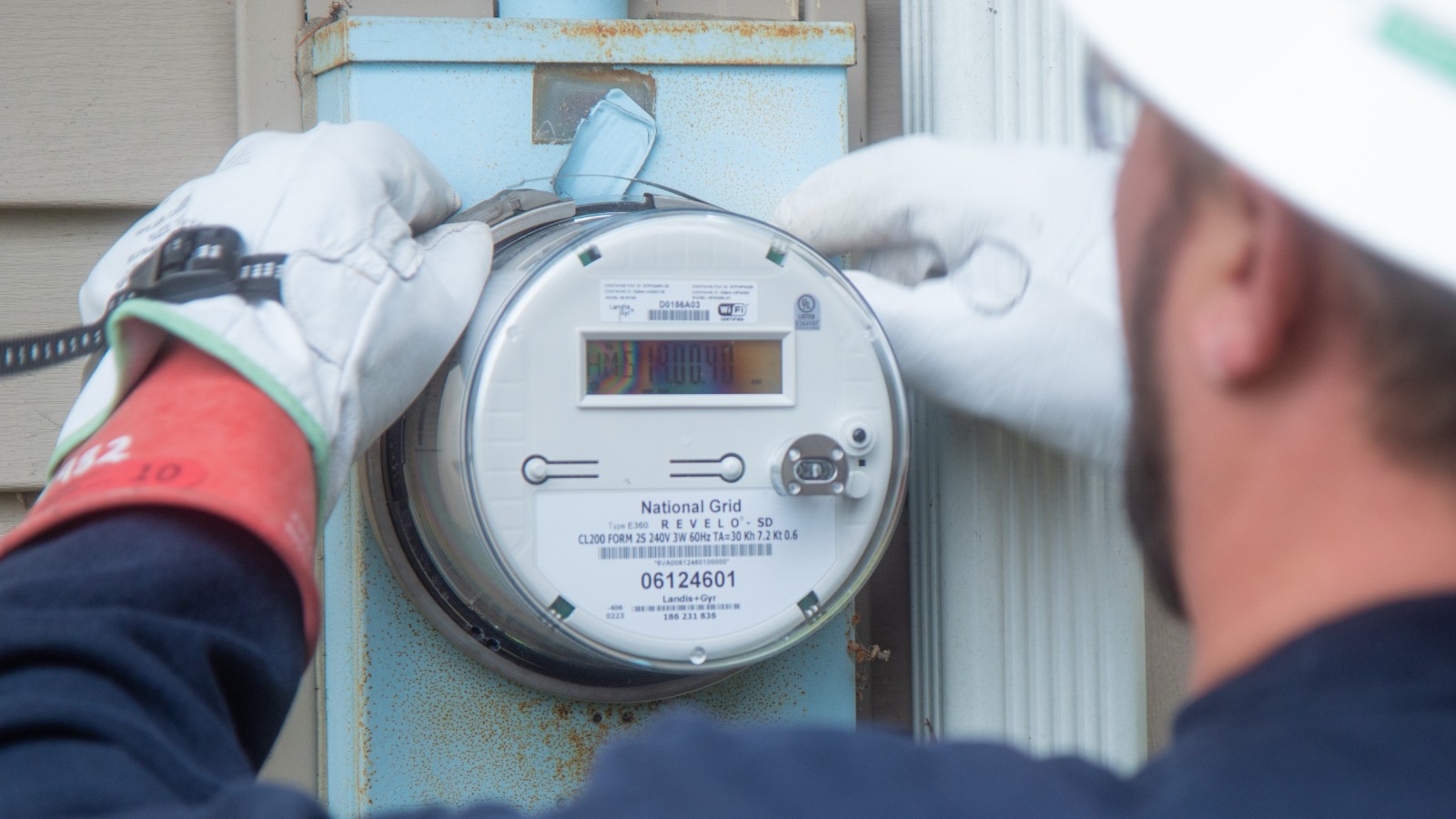
SOUTH COAST National Grid has logged opt-out requests for 930 smart meters in seven South Coast communities, and it has yet to install a manual meter for any customer who asked, state records and the company show.
The requests came from Fall River, Somerset, Swansea, Westport, Dighton, Rehoboth and Seekonk through Sept. 30, according to answers National Grid filed Oct. 21 with the Department of Public Utilities, which is reviewing what the company collects from customers for the meters. A customer who goes through with an opt-out will pay $26 a month for a worker to read the meter by hand.
Installation rates in those seven communities now range from 63% to 82%, and the company expects to finish every installation by December 2027, according to information National Grid provided to South Coast 360 on Nov. 13. That finish is later than the plan the department approved in 2022, which had National Grid replacing about 1.4 million older meters from 2024 through mid-2027, the order says. In its Oct. 21 answers, the company told the department that no town it serves had been fully converted to the new meters as of Dec. 31, 2025.
Every residential customer pays for the meters whether a household keeps one or not, and when the department approved the program in 2022 it wrote that opting out does not take a household out of the wider grid benefits: "Customers who elect to opt-out of AMI meter installation may do so and pay the opt-out fees, but they have no ability to opt-out of realizing or experiencing the distribution level benefits."
What the meters cost on every bill
National Grid projected about $487 million in costs from 2023 through 2027 for its smart meter plan, the Department of Public Utilities wrote in its Nov. 30, 2022 order. The meters and their installation made up $273.4 million of that. The department preauthorized $391.1 million for the meters, the network and the systems behind them and gave preliminary approval to another $96.1 million for customer education, analytics and related programs. Spending above those caps cannot be collected through the yearly meter charge, and under the order the company could seek it only in a later base rate case.
That charge is called the advanced metering infrastructure factor, a per-kilowatt-hour amount reset each year. Since May 1, it has been 0.318 cents per kilowatt-hour for residential customers on rates R-1 and R-2, which works out to about $1.91 a month, or about $23 a year, for a home using 600 kilowatt-hours, by our math.
This year's reset added 76 cents a month for a typical residential customer on basic service using 600 kilowatt-hours, and 22 to 52 cents for low-income customers, depending on their discount tier, according to the department's notice of the filing. When the program was approved, National Grid estimated the cost at full deployment at $2.47 a month for an average residential customer who does not heat with electricity, based on its 2027 revenue requirement, the 2022 order says.
In an April 29 order, the department let the charge take effect May 1 "subject to further investigation and reconciliation," so the $44.7 million National Grid is collecting from May 2026 through April 2027 can still be adjusted. That total includes $15.9 million in depreciation on the old meters.
What opting out costs
Only residential customers on rates R-1 and R-2 can opt out, under National Grid's opt-out tariff, M.D.P.U. No. 1566, in effect since Oct. 1, 2024. An opt-out home gets a meter that does not send readings and pays $26 a month for the manual reading, or $312 a year by our math. The tariff also charges $33 once to take out the existing meter and put in the manual one, and going back to a smart meter later costs another $33.
National Grid told the department Oct. 21 that opt-outs "remain in the intent phase," with the company planning to begin finalizing them. The tariff says no fee starts until the manual meter is in, and the $26 still applies in a month when the reading is missed and the bill is estimated. National Grid's opt-out page says landlords cannot opt out for their tenants, and that the company will revisit opt-out requests once installations are complete in an area. The department declined in 2022 to create a separate rate class for opt-out customers, so a household that opts out stays on the residential rate that carries the per-kilowatt-hour meter charge.
The requests, town by town
Fall River had requests covering eight meters by the end of 2025 and 255 more in the first nine months of this year, the most of the seven communities, National Grid's filing shows. Seekonk had the most early requests, 66, and 11 of those were later canceled. Statewide, National Grid counted requests covering 4,880 meters by the end of 2025 and 5,607 more through Sept. 30, against about 1.48 million active residential and small business customers at the end of 2025.
| Community | Through Dec. 31, 2025 | Dec. 31, 2025, to Sept. 30, 2026 | Requests through 2025 later canceled | Total requests |
|---|---|---|---|---|
| Fall River | 8 | 255 | 1 | 263 |
| Rehoboth | 28 | 107 | 1 | 135 |
| Swansea | 11 | 121 | 1 | 132 |
| Somerset | 4 | 119 | 0 | 123 |
| Seekonk | 66 | 51 | 11 | 117 |
| Dighton (with North Dighton, listed separately in 2026) | 4 | 93 | 0 | 97 |
| Westport | 4 | 59 | 0 | 63 |
| Seven communities | 125 | 805 | 14 | 930 |
The total adds both periods and does not subtract cancellations. The canceled column covers only requests made through 2025, and the company said some 2026 requests were also canceled, without giving a count. Eversource also lists Westport among the Massachusetts communities where it delivers electricity, so Westport residents can check which company's name is on the bill. Eversource's opt-out terms are different, and our Nov. 11 story covers them.
Eversource customers can read what opting out of an Eversource smart meter costs, $34 a month under its tariff.
What happens next
The department's review of this year's meter charge runs into 2027. Under the hearing officer's Oct. 30 schedule, the last round of questions to National Grid is due Dec. 1, its answers by Dec. 15, and any party wanting an evidentiary hearing has until Dec. 22 to ask. Without a hearing, initial briefs are due Feb. 4 and reply briefs Feb. 11. The filings are posted in the department's online File Room under docket 26-42.
Customers who want to opt out use the Smart Meter Opt Out Request form on National Grid's Massachusetts website, and the form has to be filled out by the person whose name is on the account.
Label: Reported by us, from the town's posted records.
Notes
Every fact comes from the state's and the company's own records: the Department of Public Utilities' Nov. 30, 2022 order approving National Grid's smart meter plan, the department's notice, Phase I order and Oct. 30 schedule in docket D.P.U. 26-42, National Grid's Oct. 21 answers and Exhibit JH-5-Revised in that docket, National Grid's opt-out tariff M.D.P.U. No. 1566 and its opt-out page, Eversource's list of the communities it serves, and National Grid's Nov. 13 email answers to our questions. We read them on Nov. 13, 2026. We checked each date and weekday against a calendar. The 600 kilowatt-hour monthly cost, the yearly opt-out cost and the town totals are our arithmetic from those records. The installation rates and the December 2027 finish come from National Grid's email only. No other news outlet is a source for this story.
Corrections
No corrections to this story. If something here is wrong, tell us. Every correction is dated on the story and listed in our public log.
Sources (10)
- Department of Public Utilities, D.P.U. 21-80-B/D.P.U. 21-81-B/D.P.U. 21-82-B, Order on New Technologies and Advanced Metering Infrastructure ProposalsOrder dated Nov. 30, 2022: National Grid projected $487.1 million, 2023 to 2027 (page 42); 1.4 million meters to be replaced 2024 to mid-2027 (page 202); bill impact estimates, footnote 103 (page 253); $391.1 million and $96.1 million caps (pages 257 to 258); opt-out findings (pages 312 to 314). Fetched from the DPU File Room. Read Nov. 13, 2026.
- Department of Public Utilities, D.P.U. 26-42, Notice of Filing and Request for CommentsNotice dated March 25, 2026: $44,668,649 requested, AMIF of $0.00318 per kWh for R-1 and R-2, typical bill increase of $0.76 a month at 600 kWh. Read Nov. 13, 2026.
- Department of Public Utilities, D.P.U. 26-42, Phase I OrderOrder dated April 29, 2026: AMIFs approved for effect May 1, 2026, subject to further investigation and reconciliation. Read Nov. 13, 2026.
- National Grid, D.P.U. 26-42, Responses to the Department's First Set of Information Requests, DPU 1-1 and DPU 1-2Filed Oct. 21, 2026: 390,806 smart meters installed by Dec. 31, 2025; zero towns fully saturated with AMI as of Dec. 31, 2025; opt-out requests by community through Dec. 31, 2025, cancellations through Sept. 30, 2026, and new requests Dec. 31, 2025 to Sept. 30, 2026; opt-outs "remain in the intent phase." Read Nov. 13, 2026.
- National Grid, D.P.U. 26-42, Exhibit JH-5-Revised, AMI DeploymentFiled Oct. 21, 2026: 1,480,799 active customers at Dec. 31, 2025. Read Nov. 13, 2026.
- Department of Public Utilities, D.P.U. 26-42, Hearing Officer Memorandum, Revised Procedural ScheduleDated Oct. 30, 2026: discovery deadlines Dec. 1 and Dec. 15, hearing request deadline Dec. 22, briefs Feb. 4 and Feb. 11, 2027. Read Nov. 13, 2026.
- Massachusetts Electric Company, Residential Advanced Meter Reading Opt-Out Provision, M.D.P.U. No. 1566Tariff issued Oct. 16, 2024, effective Oct. 1, 2024: R-1 and R-2, $26 monthly reading, $33 removal and $33 reinstallation charges, fee charged on estimated bills, no fee until the non-advanced meter is installed. Read Nov. 13, 2026.
- National Grid: Smart Meter Opt Out Request (Massachusetts)Company page, landlords cannot opt out for tenants, requests revisited once installations in an area are complete, form completed by the customer of record or account holder. Read Nov. 13, 2026.
- Eversource: Communities We ServeCompany list, Westport under its Massachusetts electric communities. Read Nov. 13, 2026.
- National Grid: email to South Coast 360Received 10:44 a.m. Nov. 13, 2026, answering our Nov. 12 questions: the seven communities it serves, installation rates of 63% to 82%, all installations by December 2027, project of about $487 million, $26 monthly opt-out fee, no opt-out manual meters installed yet.