


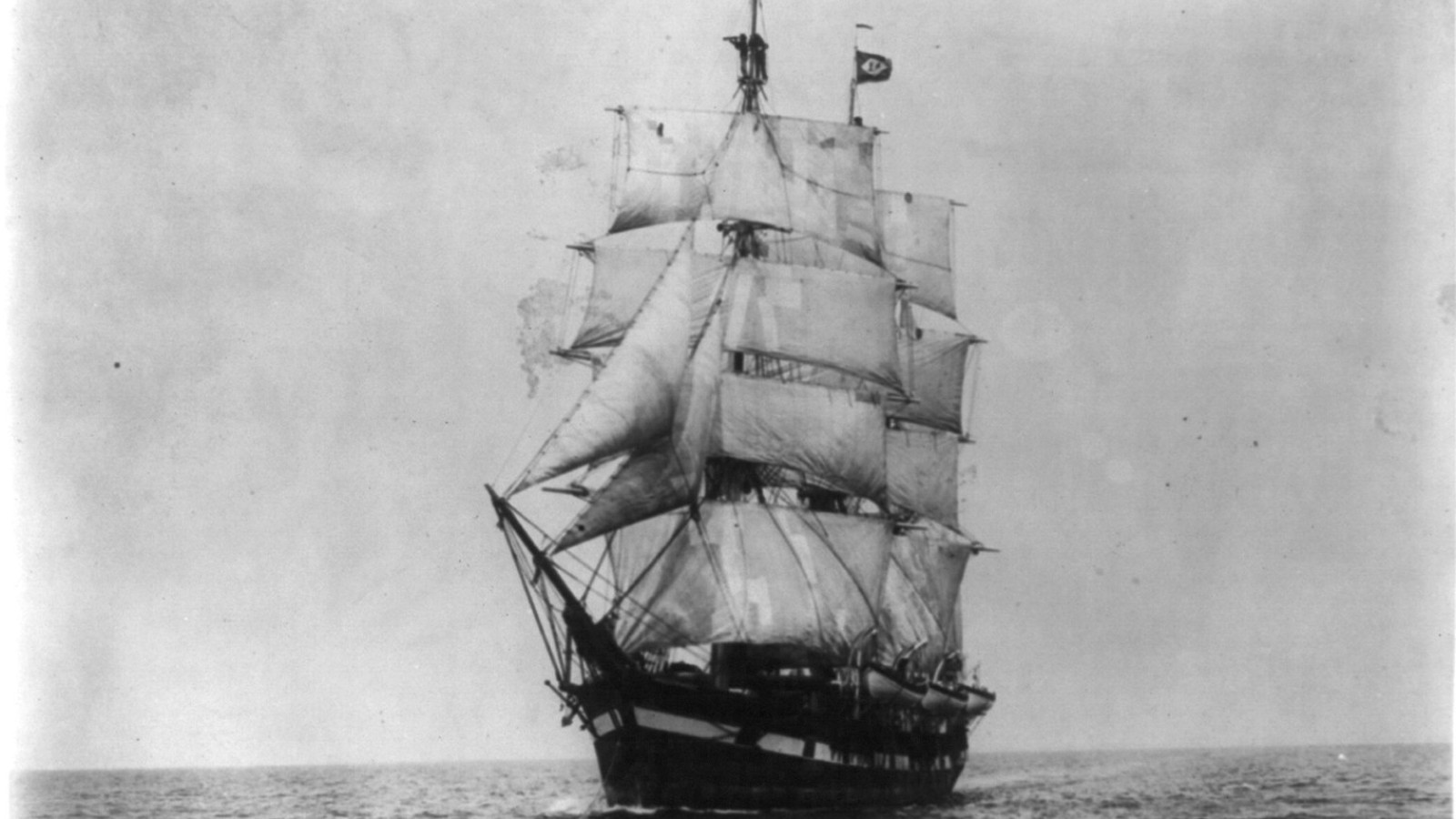
MATTAPOISETT A piece of one of the Wanderer's masts is part of the flagpole in Mattapoisett's Shipyard Park, overlooking the harbor where the whaling bark was built in 1878. The Mattapoisett Historical Commission's marker calls her the last whaler to go out of the port of New Bedford under sail. The whaling database lists New Bedford as her home port.
Whaling ran through nearly every harbor on the South Coast and up the Taunton River. The American Offshore Whaling Voyages database, kept by the New Bedford Whaling Museum, Mystic Seaport Museum and the Nantucket Historical Association, lists about 1,500 voyages from South Coast home ports other than New Bedford. Fairhaven sent out 576, the seventh most of any American port in the database, and Westport's 309 ranks ninth. New Bedford's 4,618 still lead every port.
Many of New Bedford's ships were built a few miles east, in Mattapoisett. Of the whaling vessels in the database with a recorded place of build, more than 150 came from Mattapoisett, more than from any other place and nearly twice the 82 built in New Bedford. At least 87 of the Mattapoisett-built vessels made voyages out of New Bedford.
When it was all Dartmouth
Dartmouth took in what is now New Bedford, Fairhaven and Westport until 1787, when New Bedford became a town on Feb. 23 and Westport on July 2. Fairhaven split from New Bedford on Feb. 22, 1812.
Alexander Starbuck's 1878 "History of the American Whale Fishery" dates whaling near New Bedford to "but little prior to 1760," when William Wood of Dartmouth sold land on the Acushnet River, in what is now Fairhaven, but kept back "that part of the same where the Try house and Oyl shed now stands." Starbuck, citing an earlier history of New Bedford, wrote that Joseph Russell, the city's founder, was whaling by 1755, and that in 1765 Russell, Caleb Russell and William Tallman had four sloops of 40 to 60 tons in the fishery.
In September 1772 the sloop Pluto of Acushnet, John Winslow master, and the King of Prussia of Nantucket were found bottom up, and Starbuck wrote that "it is supposed that the crews had perished." During the Revolution, the British navy raided the coast, and a return of the damage from the raid on the Acushnet River on Sept. 5, 1778, which Starbuck reprints, counted 70 vessels destroyed, along with storehouses at Bedford and Fairhaven.
Fairhaven, the second port on the harbor
Across the harbor from New Bedford, Fairhaven ran the South Coast's second whaling fleet. Of its 576 voyages, 540 sailed between 1820 and 1869, most of them in full-rigged ships. The agents with the most voyages were Ezekiel Sawin, with 69, and the firm of Gibbs & Jenney, with 45.
On Jan. 3, 1841, the new ship Acushnet sailed from Fairhaven under Capt. Valentine Pease. Gideon Barstow & Son had built her in Mattapoisett the year before. Herman Melville, 21, signed on in December 1840. After the ship rounded Cape Horn and crossed the Pacific, he and another crewman deserted in July 1842 at Nukahiva in the Marquesas Islands, according to the National Archives, which holds the crew list. The Acushnet was lost Aug. 16, 1851, on a later voyage, three months before "Moby-Dick" was published in the United States on Nov. 14.
Capt. William H. Whitfield, born in Fairhaven in 1804, commanded the bark John Howland on a voyage from 1839 to 1843. In June 1841, off the island of Tori Shima south of Japan, his crew took aboard five stranded Japanese fishermen, among them 14-year-old Manjiro Nakahama, according to the Whitfield-Manjiro Friendship Society. Whitfield brought Manjiro home to Fairhaven in 1843, and the society says Manjiro became the first Japanese person to live in America. The society also quotes a 1933 letter in which President Franklin D. Roosevelt told Manjiro's eldest son that Roosevelt's grandfather, Warren Delano of Fairhaven, had been part owner of the ship that brought Manjiro there.
Mattapoisett, the shipyard
Mattapoisett was a village of Rochester until it became a town on May 20, 1857, and the town's historical marker dates professional shipbuilding there to 1752. The marker says Gideon Barstow built the first Barstow Wharf, later called Short Wharf, for shipbuilding and was joined by his son Wilson. Ebenezer Cannon built Long Wharf, and Josiah Holmes and Benjamin Barstow built Holmes Wharf, which the Holmes family owned for more than a century.
The village sent out its own fleet too: 192 voyages from 1815 to 1864, mostly in brigs and barks, with members of the Barstow family as leading agents. The Wanderer, built by Jonathan Holmes with Arvid Cannon as master carpenter, first sailed June 4, 1878. She appeared in the 1922 film "Down to the Sea in Ships." In late August 1924 a storm drove her onto the rocks off Cuttyhunk Island, and her crew was saved.
Westport Point
Westport sent out 309 voyages, 275 of them between 1820 and 1869, mostly in brigs and barks rather than Fairhaven's bigger ships. The Westport Historical Society describes Westport Point as one of the most protected harbors in the region and says that by 1855 the town was home port to 18 to 22 whaling ships, employing 462 men and bringing in $105,000 in sperm whale oil.
Trades gathered around the Point's wharves, the society says. Isaac Palmer ran a store and sail loft, John Sowle built whaleboats, and blacksmiths Simeon Macomber and Darius Davis forged harpoons, lances and blubber hooks. Thomas Mayhew, agent for many Westport whalers, built what is now Lees Wharf, and the Cory family's store served as supply post, customhouse and post office. The database lists Andrew Hicks as the town's leading agent, with 77 voyages. The bark Andrew Hicks, built in Fairhaven in 1867, made Westport's last voyage in the database, sailing June 23, 1879, under Capt. Edward Everett Hicks, a Westport native.
Paul Cuffe, whom the Westport Historical Society calls the town's most famous resident of his era, started on a whaler. He was born on Cuttyhunk Island on Jan. 17, 1759, the son of Cuff Slocum, a formerly enslaved man from West Africa, and Ruth Moses, a Native American woman from Cape Cod. In 1773, at 14, he went to sea on a whaling voyage to the West Indies. With his brother-in-law Michael Wainer, a Wampanoag, he later built ships on the East Branch of the Westport River for trading, fishing and whaling voyages. Cuffe died Sept. 7, 1817, and is buried behind the Westport Friends Meeting House.
Dartmouth and the Padanaram yards
Of Dartmouth's 153 voyages, 81 sailed before 1790, 68 of them before New Bedford split off in 1787. From 1800 on, 67 more sailed, most of them in the 1830s or later. The last were the Cape Horn Pigeon, which sailed Sept. 6, 1876, and the Matilda Sears, which left Aug. 28, 1877, and was sold at Talcahuano, Chile, in 1882.
Both came from the Padanaram yard of Matthews, Mashow and Company. John Mashow, its master builder, was born enslaved in Georgetown, South Carolina, in 1805, freed at 10 under his father's will and apprenticed to Laban Thatcher, a South Dartmouth shipwright, according to Richard C. Kugler, then curator of the Whaling Museum, in a 1989 Standard-Times article kept in the Mattapoisett Museum's collection. Mashow built his first whaleship, the Nimrod, in 1842 and went into partnership with Alonzo Matthews in 1851. In the 1850s, Kugler said, the only larger whaleship builder was Wilson Barstow of Mattapoisett.
The database lists 15 whaling vessels built by Mashow or his firm from 1842 to 1858, including the Jireh Swift in 1853. When the firm closed in 1860, New Bedford's leading whaling owners signed a testimonial praising him "as a thorough, practical master ship-builder and as a most worthy and respected citizen." He died in New Bedford in 1893 and was buried in South Dartmouth.
Rochester, Marion and Wareham
Rochester was set up in 1686 from land called Sippican. Part of the town went to Wareham in 1739, and Marion became a town on May 14, 1852, five years before Mattapoisett. The earliest Rochester voyage in the records is the sloop Defiance, Joshua Delano master, in 1771. In March 1796 the Rochester ship Harmony, Capt. George Blankenship, "ran upon a whale off the coast of Brazil, and was stove and sunk," Starbuck wrote, and her crew was saved.
Sippican, the harbor that became Marion, whaled late and small. Most of its 107 voyages were made in schooners, and nearly all sailed from the 1840s to 1885. Starbuck counted the schooner Admiral Blake among small vessels that made extraordinary voyages: in 1854, under Capt. B.B. Handy, she came home after two months and nine days with 250 barrels of sperm oil and 10 of blackfish oil, worth $11,000. The Admiral Blake also made Marion's last voyage in the database, sailing May 15, 1885, under Capt. William C. Hathaway.
In Wareham, the database shows 37 voyages between 1773 and 1857, more than half of them in the 1840s, with M.S.F. Tobey as the leading agent. The ship George Washington, built in Wareham in 1832, sailed on her last Wareham voyage in 1857, came home in 1861 and was then sold to Honolulu.
Up the Taunton River
Nathan Durfee was the leading agent for Fall River's 66 voyages, all but one of which sailed between 1832 and 1860. The exception, the brig Sullivan, sailed in June 1912 under Capt. William Clinton Hegarty, a Somerset native, and was lost at Horta Bay on Fayal in the Azores on Oct. 14, 1913. Somerset sent out 11 voyages, eight of them in the bark Pilgrim from 1839 to 1848, and Freetown sent out three, all from 1841 to 1844.
Raiders, then petroleum
The Confederate raider Alabama captured and burned the Mattapoisett bark Ocean Rover on Sept. 9, 1862, and the Sippican schooner Altamaha four days later. Starbuck wrote that the Altamaha was among whalers that, "attracted by the burning of the Ocean Rover of Mattapoisett, hastened to rescue the shipmates whose lives they believed to be imperilled." The Alabama burned Westport's Kate Cory on April 15, 1863, and in June 1865 the raider Shenandoah burned two Mashow-built ships, the Jireh Swift and the Nimrod, in the Bering Sea and Bering Strait.
After petroleum was discovered, the Westport Historical Society says, the industry quickly died out, and by 1865 only 10 whaling vessels still worked out of Westport. The database shows Wareham's last voyage in 1857, Mattapoisett's in 1864, Fairhaven's in 1876, Dartmouth's in 1877, Westport's in 1879 and Marion's in 1885.
See it today
- Mattapoisett Shipyard Park on Water Street, where the flagpole holds part of a Wanderer mast, sits beside the old shipbuilding wharves, which the marker says the town bought or received. The Mattapoisett Museum, in an 1821 meeting house at 5 Church St., is open by appointment on Tuesdays, Thursdays and Fridays from September through May, booked by email at info@mattapoisettmuseum.org.
- Fairhaven The Whitfield-Manjiro Friendship House, Whitfield's home at 11 Cherry St., is a museum. Tours of the house and of the Manjiro Trail, which includes the Old Stone Schoolhouse, the Millicent Library and the Lewis Bartlett School, are scheduled by calling 508-858-5303.
- Westport Point Lees Wharf and the Federal-style Thomas Mayhew House of about 1827, at 2018 Main Road, date from the whaling years, as does the Westport Point cemetery, started about 1810. The Westport Historical Society is in the Bell School, built about 1841, at 25 Drift Road and can be reached at 508-636-6011. Its online exhibit "A Perilous Life" covers Westport whaling.
- New Bedford The New Bedford Whaling Museum, 18 Johnny Cake Hill, has the half-scale whaling bark model Lagoda, and the New Bedford Whaling National Historical Park can be reached at 508-996-4095.
- Online Voyages, captains and agents for every port in this story can be searched free at whalinghistory.org, along with whaling crew lists.
Label: Reported by us, from the town's posted records.
Notes
Voyage, ship, captain, agent and builder facts come from the American Offshore Whaling Voyages database of the New Bedford Whaling Museum, Mystic Seaport Museum and the Nantucket Historical Association, edition of June 19, 2026. Early history comes from Alexander Starbuck's 1878 history, and town dates from the published vital records of Dartmouth, New Bedford and Rochester. The rest comes from the National Archives, the Westport Historical Society, the Mattapoisett Historical Commission, the Mattapoisett Museum, the Whitfield-Manjiro Friendship Society and the museum and park pages listed with this story, all read Oct. 24. We checked each date against its record. Not heard: no one was contacted.
Corrections
No corrections to this story. If something here is wrong, tell us. Every correction is dated on the story and listed in our public log.
Sources (24)
- American Offshore Whaling Voyages: A Database | Whaling History (download page)New Bedford Whaling Museum, Mystic Seaport Museum and Nantucket Historical Association; CC BY 4.0; voyages file updated June 19, 2026. Downloaded and counted Oct. 24, 2026 (voyages by home port, rank, decade, rig, agent, master, master's birth year and place, build place, builder, fate). Includes William H. Whitfield, born Nov. 4, 1804, Fairhaven, master of the John Howland 1839 to 1843; the Acushnet (built Mattapoisett 1840 by Gideon Barstow & Son, sailed Jan. 3, 1841, lost Aug. 16, 1851); the Wanderer (built Mattapoisett 1878 by Jonathan Holmes, Arvid Cannon master carpenter). Read Oct. 24, 2026.
- American Offshore Whaling Voyages data viewer | Whaling HistoryPublic search of the same database, including crew lists. Read Oct. 24, 2026.
- History of the American Whale Fishery from Its Earliest Inception to the Year 1876, Alexander Starbuck (1878) | Internet ArchiveReport of the U.S. Commission of Fish and Fisheries, public domain. The 1760 Fairhaven try house deed, Joseph Russell and the 1765 sloops, Newport clearances, the Pluto of Acushnet (1772), the 1778 Acushnet River return, the Harmony of Rochester (1796), the Admiral Blake of Sippican (1854) and the Alabama's 1862 captures. Read Oct. 24, 2026.
- Vital Records of Dartmouth, Massachusetts, to the Year 1850 (1929) | Internet ArchiveTown history note: New Bedford established Feb. 23, 1787, and Westport July 2, 1787, from Dartmouth. Read Oct. 24, 2026.
- Vital Records of New Bedford, Massachusetts, to the Year 1850 (1932) | Internet ArchiveTown history note: Fairhaven set off Feb. 22, 1812. Read Oct. 24, 2026.
- Vital Records of Rochester, Massachusetts, to the Year 1850 (1914) | Internet ArchiveTown history note: Rochester established June 4, 1686, from common land called Sippican; part to Wareham July 10, 1739; Marion May 14, 1852; Mattapoisett May 20, 1857. Read Oct. 24, 2026.
- Herman Melville: A Voyage into History, Prologue, Fall 2009 | National ArchivesThe Acushnet sailing out of Fairhaven; Melville signed on December 1840 at 21; deserted July 1842 at Nukahiva; 11 of 26 deserted; Moby-Dick published in the U.S. Nov. 14, 1851; crew list at the National Archives in Waltham. Read Oct. 24, 2026.
- Mattapoisett Wharves marker, Mattapoisett Historical Commission (2001) | Historical Marker DatabaseMarker text: Barstow, Long and Holmes wharves, sold or given to the town, the Acushnet, the J.H. Holmes & Son Shipyard, the Wanderer's first voyage June 4, 1878, the 1922 film, the 1924 wreck off Cuttyhunk with the crew saved, the mast in the Ship Yard Park flagpole; marker reached from Water Street. Read Oct. 24, 2026.
- Industrial Period (1830 to 1915) | Westport Historical SocietyWestport home port to 18 to 22 whaling ships in 1855, 462 men, $105,000 of sperm oil; petroleum and the decline; 10 vessels by 1865. Read Oct. 24, 2026.
- Federal Period (1775 to 1830) | Westport Historical SocietyWestport incorporated July 2, 1787; Paul Cuffe. Read Oct. 24, 2026.
- Westport Point | Westport Historical SocietyWharves, Cory store, Thomas Mayhew House (ca. 1827) at 2018 Main Road, Westport Point cemetery (ca. 1810), the Kate Cory built by Frank Sisson and Eli Allen. Read Oct. 24, 2026.
- 'No place in the world like Westport Point' | Westport Historical SocietyProtected harbor, trades, Isaac Palmer, John Sowle, Simeon Macomber, Darius Davis, Thomas Mayhew and Lees Wharf. Read Oct. 24, 2026.
- Paul Cuffe | Westport Historical SocietyBorn Cuttyhunk Jan. 17, 1759; parents; 1773 whaling voyage at 14; Michael Wainer; ships on the East Branch; died Sept. 7, 1817; buried behind the Westport Friends Meeting House. Read Oct. 24, 2026.
- About the Westport Historical SocietyBell School (circa 1841) at 25 Drift Road; 508-636-6011. Read Oct. 24, 2026.
- A Perilous Life: Westport Whaling | Westport Historical SocietyThe society's online whaling exhibit, linked from its Online Exhibitions menu. Read Oct. 24, 2026.
- 1989 article on John Mashow | Mattapoisett Museum collection (CatalogIt)Newspaper article in the Mattapoisett Museum's catalog (dated Feb. 19, 1989, in the catalog record), quoting Whaling Museum curator Richard C. Kugler and the June 30, 1860, testimonial: born 1805 in Georgetown, S.C.; freed 1815; Laban Thatcher; Nimrod 1842; Matthews, Mashow and Company 1851; Wilson Barstow the only larger builder; yard on Elm Street; died 1893, buried in South Dartmouth. Read Oct. 24, 2026.
- Visit | Mattapoisett MuseumOff-season hours September to May: Tuesday, Thursday and Friday by appointment; email appointments any time; 5 Church St. Read Oct. 24, 2026.
- Mattapoisett MuseumHoused in an 1821 meeting house; footer email info@mattapoisettmuseum.org. Read Oct. 24, 2026.
- Captain Whitfield's Story | Whitfield-Manjiro Friendship SocietyWhitfield born 1804 in Fairhaven; commanded the John Howland; June 1841 rescue of five Japanese fishermen at Tori Shima, among them Manjiro, 14. Read Oct. 24, 2026.
- John Manjiro's Story | Whitfield-Manjiro Friendship SocietyRescued by Whitfield aboard the John Howland in 1841; brought to Fairhaven on return in 1843; first Japanese person to live in America (the society's statement); 1933 letter from President Franklin D. Roosevelt to Toichiro Nakahama naming his grandfather Warren Delano of Fairhaven as part owner of the ship that brought Manjiro to Fairhaven. Read Oct. 24, 2026.
- The Manjiro House | Whitfield-Manjiro Friendship Society11 Cherry St., Fairhaven; Manjiro rescued at sea in 1841; first Japanese person to live in America (the society's statement); the Manjiro Trail; tours 508-858-5303. Read Oct. 24, 2026.
- Visit | New Bedford Whaling Museum18 Johnny Cake Hill; the half-scale model Lagoda. Read Oct. 24, 2026.
- New Bedford Whaling National Historical Park | National Park ServicePark phone (508) 996-4095. Read Oct. 24, 2026.
- The ship WANDERER used in movie "Down to the Sea in Ships" (1922) | Wikimedia Commons, from the Library of CongressLead photo, Library of Congress LCCN 2002710422, no known restrictions on publication (https://www.loc.gov/pictures/item/2002710422/). Read Oct. 24, 2026.
