




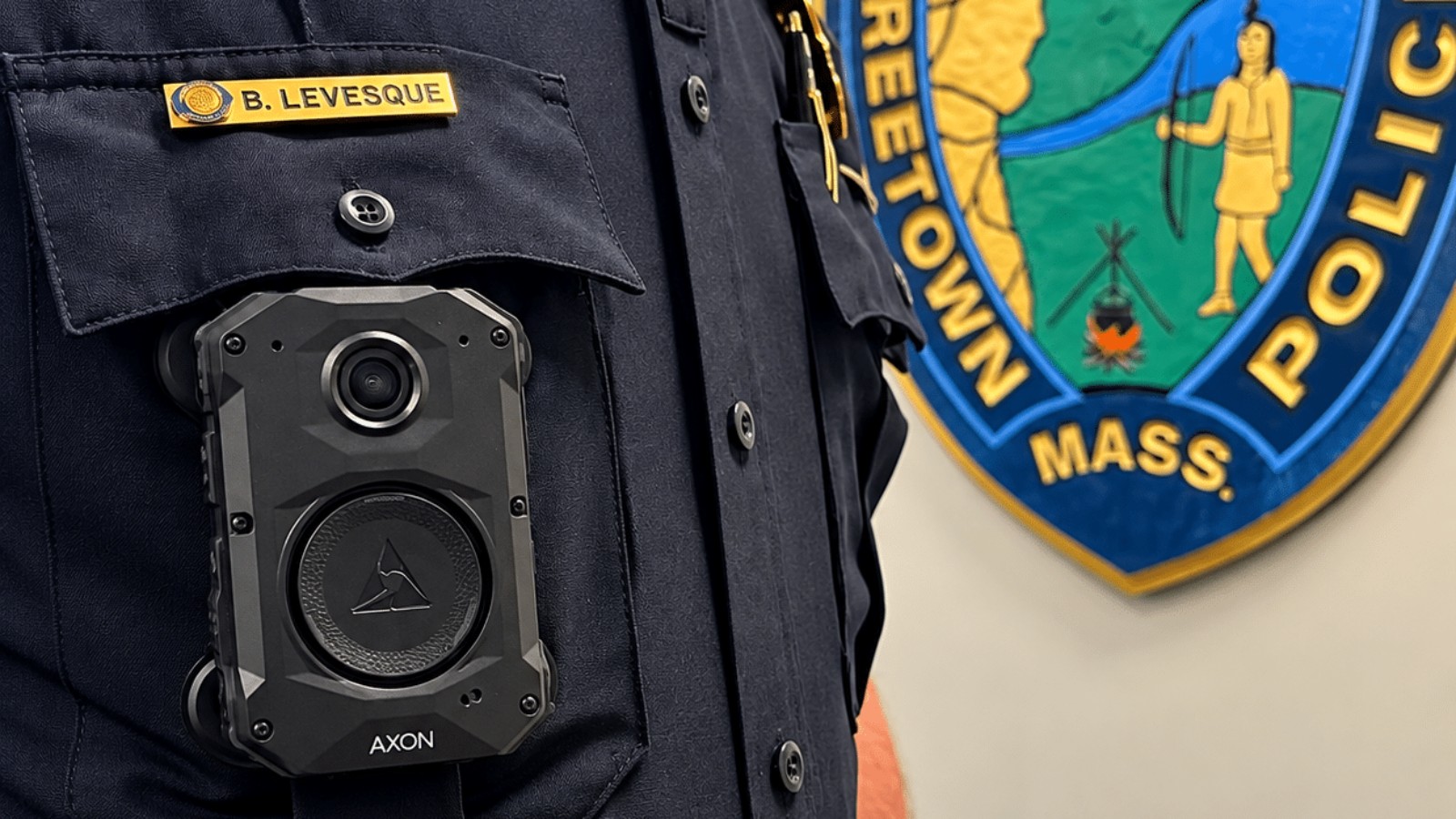
FREETOWN Freetown police officers now wear body cameras that they are generally required to turn on for traffic stops, arrests and other enforcement calls, and how long each recording is kept depends on the case, Chief Scott M. Rose said Monday.
The department received 25 cameras and support equipment through the state's body camera grant program and has assigned cameras to 22 officers so far, Rose said in an email to South Coast 360. The program officially began Friday, Nov. 6, after mandatory training on running the cameras, when to turn them on, department policy, privacy and handling recorded evidence.
For residents, the department's rules set when an encounter with an officer is likely to be on camera and how long the video stays in the department's system, from 30 days for recordings with no longer period to indefinitely for a death investigation.
When the cameras go on
A department rule, Policy No. 409, governs how the cameras are used and how recordings are managed and kept. Officers are "generally required to activate their cameras, when reasonably practicable," during traffic stops, calls for service involving enforcement-related contact with civilians, criminal investigations, arrests and incidents involving the use of force, Rose said.
The policy leaves room for an officer's judgment in some situations, he said, particularly when the need to document police work has to be balanced against a person's privacy, officer safety or the integrity of an investigation. Officers are expected to tell people they are being recorded when reasonably practicable. The cameras are not meant to record every interaction continuously, Rose said, particularly routine community engagement and other non-enforcement activity.
How long recordings are kept
Rose listed these retention periods from the policy:
- Indefinitely: death investigations, fatal motor vehicle crashes and sexual assault investigations.
- 11 years: use-of-force incidents and felony offenses.
- 7 years: misdemeanor offenses, nonfatal motor vehicle crash investigations and certain missing-person investigations.
- 3 years: certain noncriminal investigations and significant public safety events.
- 180 days: traffic stops, certain officer-initiated encounters, medical and mental health assistance, public assists and detainee transports, unless a longer period applies.
- 30 days: recordings not subject to a longer period, except where department policy specifically authorizes deletion.
Recordings may be kept past those periods when the law requires it or for investigative, evidentiary or litigation reasons, Rose said. The schedule is meant to support state municipal records rules, the recordkeeping requirements of the Massachusetts Peace Officer Standards and Training Commission and the recommendations of the state's body camera task force, he said.
The video sits in a secure, cloud-based evidence system, and all recordings and related data remain the property of the Town of Freetown and under the immediate control of the Police Department, Rose said. The department limits who can reach the recordings, and the system keeps audit records of who viewed and shared them.
Who paid for it
Rose said the cameras and equipment came through the state grant program and did not give a dollar figure. A March 3 release from Gov. Maura Healey's administration lists a $149,898 award to the Freetown Police Department from that program, the Law Enforcement Body-Worn Camera Program, which also covers costs such as onsite data storage, batteries and charging docks. Two of Freetown's neighbors were on the same list, with Lakeville police receiving $65,989 and Berkley police $155,236.
That round, about $3.49 million shared by 32 departments, was the last under the five-year program in the state's capital plan for fiscal 2022 through 2026, the release said. In its first four years, the program helped 144 local police departments buy more than 4,800 cameras.
What the chief says
"This technology provides an additional means of documenting police interactions, preserving valuable evidence, and protecting both our officers and the members of the community we serve," Rose said in a statement. "Our responsibility is to ensure that this technology is utilized appropriately, with careful consideration given to public safety, individual privacy, and the rights of everyone involved."
Rose thanked the state for the grant money and said the department appreciates Bristol County District Attorney Thomas Quinn's "longstanding support of body-worn camera programs."
Rose announced the program Oct. 23, saying the department would begin using its new Axon camera system at 4 p.m. Nov. 6, after more than six months of work between department leaders and union representatives on the policy.
What happens next
The department said in October that it will evaluate the program as it goes on and adjust training and procedures as needed. Requests for police records go to the department's records access officer, Rose, by email at policesecretary@freetownpolice.org or by phone at 508-763-4017.
Label: Reported by us, from the town's posted records.
Notes
Every fact about the program comes from Freetown Police Chief Scott M. Rose's email to South Coast 360 on Nov. 9, 2026, and the department's Oct. 23 release and public records page. The grant figures come from the state's March 3 release, read as reprinted by MassInsider because the mass.gov copy did not load for us. Quotes are word for word. We checked each date and weekday against a calendar. We have not read Policy No. 409 itself; its terms here are as the chief described them. The chief gave no dollar figure, and the state's award is not stated to be the full cost of the Axon system.
Corrections
No corrections to this story. If something here is wrong, tell us. Every correction is dated on the story and listed in our public log.
Sources (4)
- Freetown Police Department: Chief Scott M. Rose, email to South Coast 360, Nov. 9, 2026, 8:26 a.m.Camera and officer counts, Nov. 6 start, training, Policy No. 409 activation rules, retention periods, storage, audit records, statement. Read Nov. 9, 2026.
- Freetown Police Department: Freetown Police Department Announces Launch of BWC Program (press release, Oct. 23, 2026)Axon system, Nov. 6 at 4 p.m., more than six months of policy work with union representatives, evaluation of the program. Read Nov. 7, 2026.
- Freetown Police Department: Public Records RequestRecords access officer Chief Scott M. Rose; phone 508-763-4017; email policesecretary@freetownpolice.org. Read Nov. 7, 2026.
- Healey-Driscoll Administration Awards Nearly $3.5 Million for Police Body-Worn Cameras (state press release, March 3, 2026)Freetown $149,898, Lakeville $65,989, Berkley $155,236; 32 departments, about $3,490,000, final round; 144 departments and more than 4,800 cameras in the first four years; related costs covered. Text read from the MassInsider reprint (massinsider.net/press-releases/43503) because the mass.gov page did not load for us. Read Nov. 7, 2026.