




DARTMOUTH After the Plymouth colonists brought in their first harvest, Massasoit came to the settlement with some 90 of his men, and for three days the Wampanoag and the English ate together.
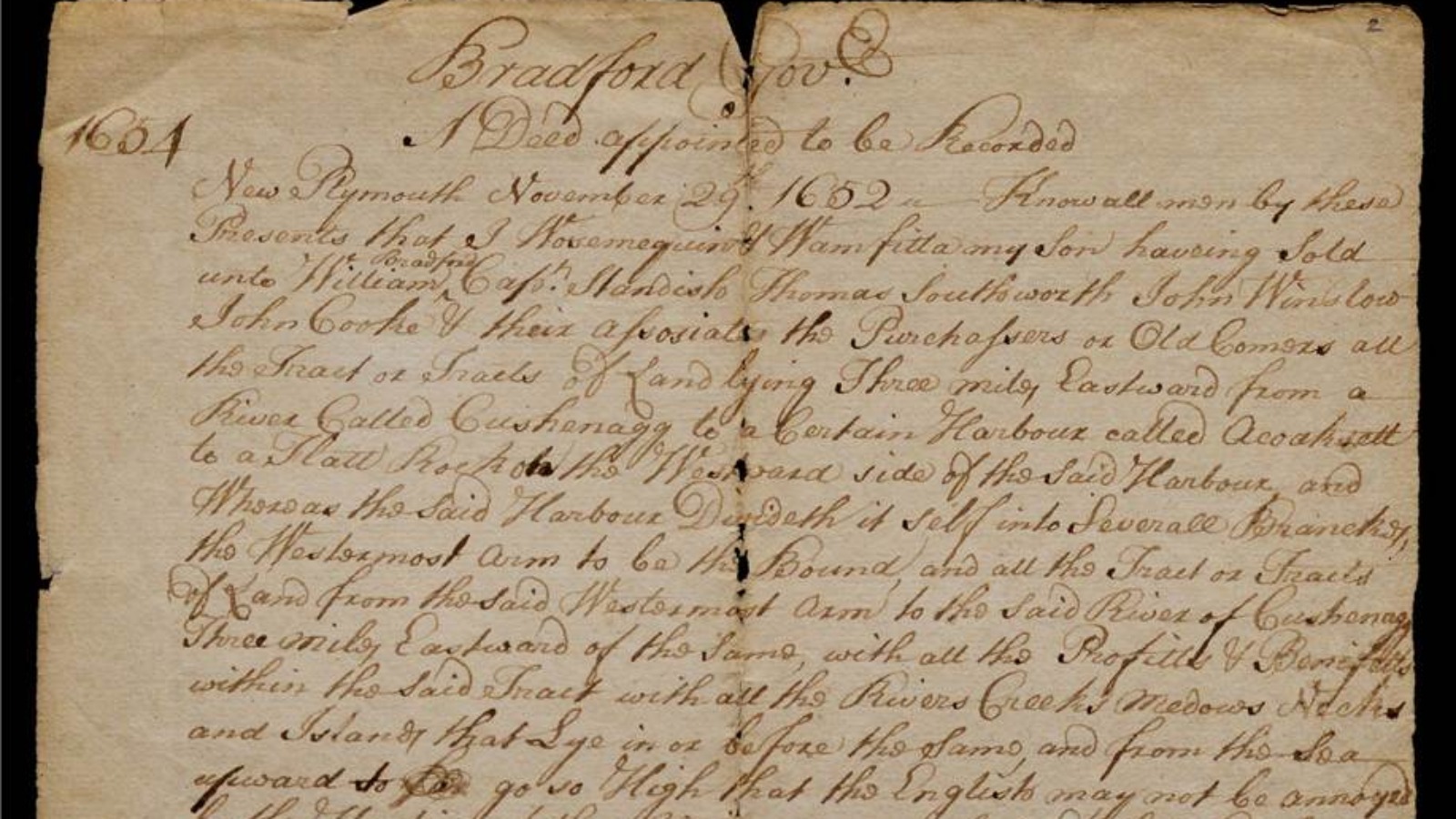
Thirty-one years later, in a deed dated Nov. 29, 1652, Massasoit and his son Wamsutta sold Plymouth's earliest settlers the land that became Old Dartmouth, the township that until 1787 took in what are now New Bedford, Dartmouth, Westport, Fairhaven and Acushnet, according to Leonard Bolles Ellis's 1892 History of New Bedford. The price, written into the deed line by line, was cloth, tools, clothing, kettles and 2 pounds in wampum.
The date on that deed comes around again on Sunday, Nov. 29, at the close of Thanksgiving week, and the deed survives in a handwritten copy held by the Gilder Lehrman Institute of American History. Read beside the colonists' own account of 1621, the old town histories, a state report from 1861 and the histories the Wampanoag tribes publish in their own words, it tells how the land under many South Coast holiday tables changed hands, and what became of the people who sold it.
Three days in 1621
The colonists' own account of that first harvest comes from a letter Edward Winslow sent to a friend in England, dated Dec. 11, 1621, and reprinted in Alexander Young's 1841 Chronicles of the Pilgrim Fathers. "Our harvest being gotten in, our governor sent four men on fowling, that so we might, after a special manner, rejoice together after we had gathered the fruit of our labors," Winslow wrote, and the four killed enough birds in one day to feed the company almost a week.
Many of the Indians came among them, he wrote, "and among the rest their greatest king, Massasoyt, with some ninety men, whom for three days we entertained and feasted; and they went out and killed five deer, which they brought to the plantation, and bestowed on our governor, and upon the captain and others." Young, writing two centuries later, added a footnote that has followed the letter ever since: "This was the first Thanksgiving, the harvest festival of New England."
The Wampanoag remember the years before that feast through their own losses. The contact timeline the Mashpee Wampanoag Tribe publishes on its culture page, written by jessie little doe baird, says traders from Europe brought a sickness to Wampanoag country in 1616 that killed fully two-thirds of a nation the tribe estimates at 45,000 people, in 69 tribes from present-day Provincetown to Narragansett Bay. When the Mayflower came across Cape Cod Bay to Pahtuksut, now Plymouth, the people there waited another three months before approaching the newcomers, the timeline says, "for fear of more disease being brought ashore."
Thirty yards of cloth and eight moose skins
The deed of 1652 names its buyers as William Bradford, Capt. Myles Standish, Thomas Southworth, John Winslow and John Cooke "and their associates, the purchasers or old-comers." Plymouth gave the name old comers to those who "came in the first three ships, the Mayflower, the Fortune, and the Ann," Young wrote, and a list from the colony's deed books, which Ellis reprinted, divides the purchase into 34 shares held by names that include Bradford, Standish, John Alden, George Soule and Francis Cooke.
The sellers are "I, Wesamequen, and Wamsutta my son," as the copy printed in Daniel Ricketson's 1858 History of New Bedford gives them. Ricketson identified Wesamequen as Massasoit, also written Woosamequin, the chief sachem of the Wampanoag, and wrote that Wamsutta, whom the English called Alexander, and his younger brother Philip, "whose true name was Pometacom," made their home at Montaup, or Pokanoket, now Mount Hope near Bristol, R.I. The people who lived on the land being sold, the Acushnets, Apponegansets and Acoaxsets, were part of the Wampanoag nation, Ricketson wrote.
The tract ran from three miles east of "a river called Cushenagg" west to "a certain harbour called Acoaksett," to a flat rock on the harbor's western side, with all the rivers, creeks, meadows, necks and islands in between, and from the sea inland "so high that the English may not be annoyed by the hunting of the Indians in any sort of their cattle." Another line dealt with the people already living there. "And I, Wesamequen, and Wamsutta, do promise to remove all the Indians within a year from the date hereof that do live in the said tract," it reads.
In return the purchasers agreed to pay 30 yards of cloth, eight moose skins, 15 axes, 15 hoes, 15 pairs of breeches, eight blankets, two kettles, one cloak, 2 pounds in wampum, eight pairs of stockings, eight pairs of shoes, one iron pot and 10 shillings in other goods. Jonathan Shaw and Samuel Eddy witnessed it, and John Winslow, John Cooke and Wamsutta, by his mark, signed it. Ellis's 1892 printing gives the wampum as 22 pounds and the cloak as a cloth, but the handwritten copy and Ricketson's printing both read one cloak and 2 pounds.
Marked oaks to the Watuppa
The colony made the purchase a town in June 1664, when the court at Plymouth allowed "all that tract of land commonly called and known by the name Acushena, Ponagansett and Coaksett" to be a township, "henceforth called and known by the name of Dartmouth," according to the court order Ricketson copied from the colony records.
That autumn the court asked Philip, "Sagamore of Pokannockett," to name an agent to mark the bounds, and on Nov. 19, 1664, he sent John Sassamon, the colony's deed record says. Sassamon set the line from a black oak "marked on four sides" at Acushena, running eight miles north into the woods, and from a white oak at the head of the cove at Akoaksett, running six and a half miles north "to a great pond," which the record says "is called Watuppa."
Eleven years later the colonists and the Wampanoag were at war. Ellis wrote that Sassamon was found dead under the ice of a pond at Middleborough, that three Native men tried before an English jury were hanged for his death, and that the fighting, now called King Philip's War, began in June 1675 with the burning of two houses at Swansea. In October the colony court recorded that most of the homes in Dartmouth had been destroyed and ordered the settlers to rebuild so they would "live compact together, at least in each village." The tribe's longer timeline of Wampanoag history gives the cost to the Wampanoag: more than 40% of the people were killed, and many of the men who survived were sold into slavery.
The families who stayed
Wampanoag families never left the South Coast. Under an act of April 6, 1859, the state named a commissioner, John Milton Earle, to report on the Indians of Massachusetts, and his report, printed in 1861, counted 111 descendants of the Acushnet, Acoaxet and Apponeganset bands living in the old township or only briefly away, with their largest settlement on the west side of the Westport River. They still claimed tracts of land in Dartmouth and Westport "to which, they affirm that the Indian title was never extinguished," Earle wrote, and their claim was heard at a public hearing in New Bedford whose last session was held Aug. 31, 1859. Earle also counted the mariner Paul Cuffe, who sailed to the west coast of Africa in a vessel of his own with a crew of men of color, as a native of the Dartmouth tribe.
On the east shore of North Watuppa Pond, about five miles from the business district of Fall River, Earle found the reservation of the Fall River, or Troy, tribe, 78 people in all. The reservation went back to 1701, when the province granted land to Capt. James Church and members of his company of Native men for their service, the report says, and after part of it was exchanged for land nearby, on Nov. 27, 1707, the lots were confirmed to them and their heirs on the condition that it was "not to be assigned or alienated, but continued forever, an Indian Plantation." A survey the province accepted in 1764 counted 190 acres.
The Pocasset Wampanoag Tribe told The New Bedford Light in 2022 that its members number about 250 and have worked for 30 years to regain control of 96 acres of that reservation east of North Watuppa Pond, the remnant of about 200 acres, roughly half of which the state granted to Fall River for its water supply by 1907, the Light reported. "We were always brought up to the land," Donna Page, a medicine woman for the Pocassets, told the Light. The Light noted that its column described the Pocasset Wampanoag Tribe of Massachusetts and Rhode Island, which it said the state Commission on Indian Affairs recognizes, and that a separate group calls itself the Pocasset Wampanoag Tribe of the Pokanoket Nation. That group says on its own website that it holds the Watuppa Pond Reservation and that its council of chiefs and clan families descend from the families in the Earle report.
Through it all
The Aquinnah and Mashpee tribes both hold federal recognition, by their own published histories. The Wampanoag Tribe of Gay Head (Aquinnah) says it obtained federal acknowledgment in 1987, and the Mashpee tribe's timeline says it became federally recognized in 2007. By the Aquinnah tribe's count, the Wampanoag Nation once took in all of southeastern Massachusetts and eastern Rhode Island, more than 67 distinct tribal communities.
This week, 374 years after Wamsutta made his mark on the deed, families across the old township will sit down to a feast whose first telling, in a colonist's letter home, puts Massasoit and his men at the table.
The Aquinnah history lists Cranberry Day and the Legends of Moshup Pageant among the tribe's yearly celebrations, says beadwork, basket making and pottery are still taught and the Wampanoag language is being taught to tribal members, and puts the tribe's story in a single line: "Through it all we have not forgotten who we are."
Label: Reported by us, from the town's posted records.
Notes
Every fact comes from the records, histories and tribal publications in the sources list below, and each is credited in the story. The 1621 harvest comes from Edward Winslow's letter as Alexander Young printed it in 1841; the deed from the scan of the handwritten copy the Gilder Lehrman Institute of American History holds, checked line by line against Daniel Ricketson's 1858 printing; the purchasers' shares, the war's start and the extent of Old Dartmouth from Leonard Bolles Ellis's 1892 history; the 1664 township order, the bounds and the 1675 court order from the colony records Ricketson copied; the families of the 1850s from John Milton Earle's 1861 report to the governor; the Watuppa land today from The New Bedford Light, as credited; and the Wampanoag account of the 1600s and of today from the Mashpee Wampanoag Tribe's two timelines, the Aquinnah tribe's history page and the Pokanoket Nation group's own website. We read them on Nov. 24, 2026, and checked each date and weekday against a calendar. Where the sources differ, we used the record: Ellis prints the wampum as 22 pounds and the cloak as a cloth, while the handwritten copy and Ricketson both read 2 pounds and one cloak, and the story says so; the Mashpee contact timeline counts 69 Wampanoag tribes and the Aquinnah history more than 67 communities, and the story credits each count to its tribe. Dates from the 1600s are given as the colony wrote them. Not heard: we did not interview anyone for this piece; the Pocasset count, the 96 acres and Donna Page's words are the Light's reporting from 2022.
Corrections
No corrections to this story. If something here is wrong, tell us. Every correction is dated on the story and listed in our public log.
Sources (10)
- Chronicles of the Pilgrim Fathers of the Colony of Plymouth, from 1602 to 1625, by Alexander Young, Boston, Charles C. Little and James Brown, 1841, chapter 15, Edward Winslow's letter dated Dec. 11, 1621, pages 230 to 232, and the note on page 352 on the old comers | Internet ArchiveThe harvest, the four men sent fowling, Massasoit and some ninety men feasted three days, the five deer, the date of the letter, Young's note naming Winslow as its writer, his footnote calling it the first Thanksgiving, and the old comers of the first three ships. Read Nov. 24, 2026.
- History and Culture of the Mashpee Wampanoag, Contact Timeline for Mashpee Wampanoag, by jessie little doe baird | Mashpee Wampanoag TribeThe 1616 sickness and the loss of two-thirds of a nation estimated at 45,000, the 69 tribes from Provincetown to Narragansett Bay, and the three months at Pahtuksut. Read Nov. 24, 2026.
- A Brief Timeline of Wampanoag History, by jessie little doe baird | Mashpee Wampanoag TribeKing Philip's War, with more than 40% of the Wampanoag killed and many men sold as slaves, and federal recognition of the Mashpee Wampanoag Tribe in 2007. Read Nov. 24, 2026.
- A Deed Appointed to be Recorded (Dartmouth Purchase), New Plymouth, Nov. 29, 1652, handwritten copy, Gilder Lehrman Collection GLC02924.02 | Gilder Lehrman Institute of American History, via Wikimedia Commons (public domain)The deed's date, buyers, sellers, bounds, the removal promise, the price, the witnesses and the signers, read from the scan of the document itself. Read Nov. 24, 2026.
- The History of New Bedford, Bristol County, Massachusetts, by Daniel Ricketson, New Bedford, 1858, chapters 1 and 2, pages 16 to 21, and the colony court orders | Internet ArchiveThe deed as printed, Wesamequen as Massasoit or Woosamequin, Wamsutta called Alexander, Philip whose true name was Pometacom, Montaup, the Acushnets, Apponegansets and Acoaxsets, the June 1664 township order, the Nov. 19, 1664 bounds set by John Sassamon from the colony's Record of Deeds, Book 3, page 323, and the Oct. 14, 1675 court order. Read Nov. 24, 2026.
- History of New Bedford and Its Vicinity, 1602 to 1892, by Leonard Bolles Ellis, Syracuse, D. Mason and Co., 1892, chapter 2 and chapter 21 | Internet ArchiveThe deed as Ellis printed it, with 22 pounds and one cloth; the list of 34 shares from the colony's deed books; the death of Sassamon, the trial and the start of the war at Swansea in June 1675; and the 1787 division of Dartmouth, which then took in Acushnet, Dartmouth, Westport, Fairhaven and New Bedford. Read Nov. 24, 2026.
- Report to the Governor and Council, concerning the Indians of the Commonwealth, under the Act of April 6, 1859, by John Milton Earle, Commissioner, Senate No. 96, Boston, William White, 1861, the Fall River Tribe and the Dartmouth Indians | Internet ArchiveThe 111 Dartmouth descendants and the west side of the Westport River, the land claim and the New Bedford hearing of Aug. 31, 1859, Paul Cuffe, the Fall River or Troy reservation on North Watuppa Pond and its 78 people, the 1701 grant, the Nov. 27, 1707 confirmation and the 190 acres. Read Nov. 24, 2026.
- Pocasset Tribe fights to gain control of Fall River land they were given 300-plus years ago, by Jack Spillane | The New Bedford LightPublished May 12, 2022. The 96 acres, the roughly 200 acres and the 1907 grant to Fall River, the tribe's count of about 250 members, Donna Page's words, and the editor's note on the two groups using the Pocasset name. Read Nov. 24, 2026.
- Pocasset | The Pocasset Wampanoag Tribe of the Pokanoket NationThe group's own statement that it holds the Watuppa Pond Reservation and that its council of chiefs and clan families descend from the Earle report (the page dates the report 1865; the state printed it in 1861). Read Nov. 24, 2026.
- Wampanoag History | Wampanoag Tribe of Gay Head (Aquinnah)Federal acknowledgment in 1987, the more than 67 tribal communities of the Wampanoag Nation, Cranberry Day and the Legends of Moshup Pageant, the arts and the language being taught, and the line "Through it all we have not forgotten who we are." Read Nov. 24, 2026.