




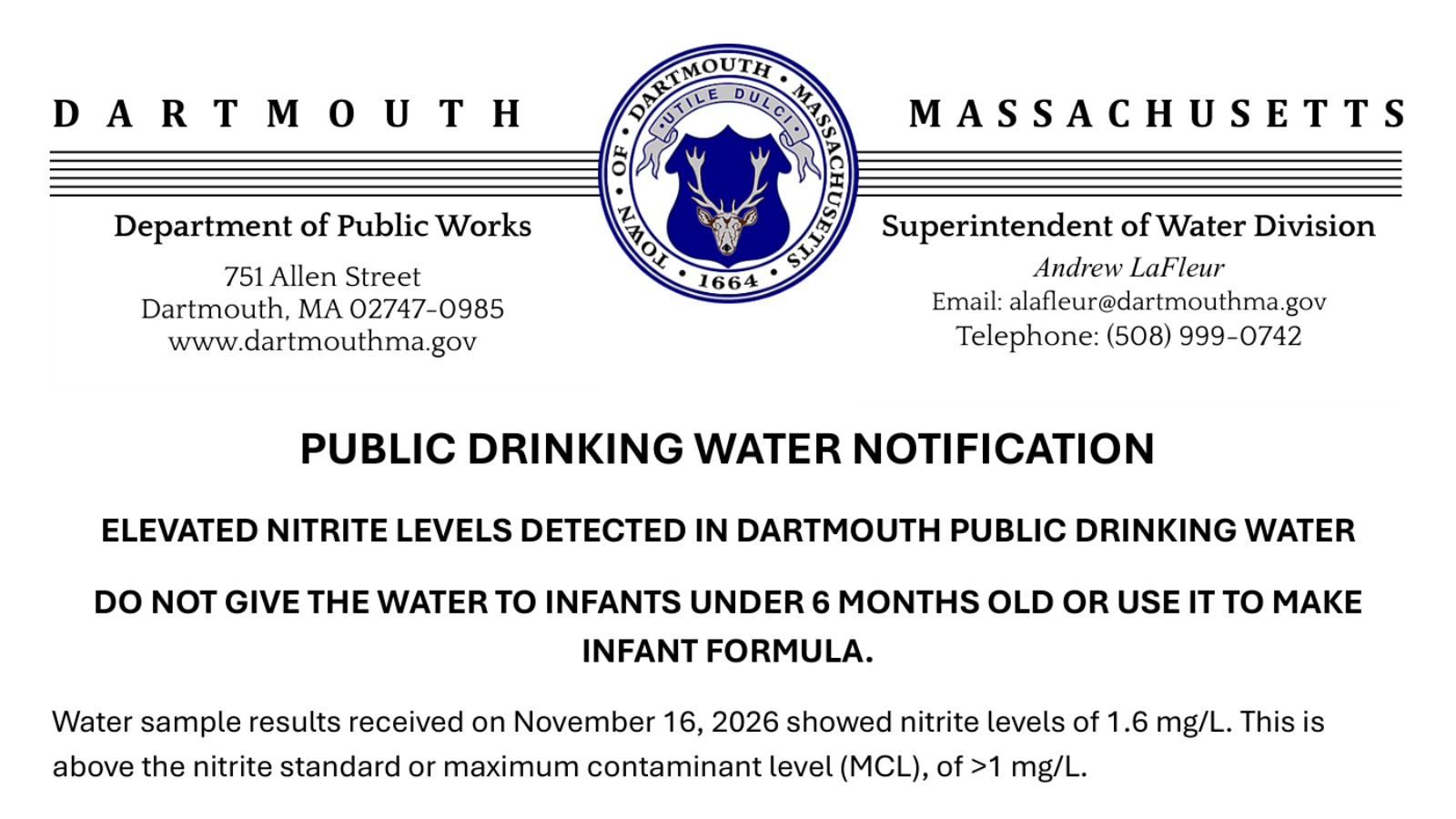
DARTMOUTH Dartmouth's Water Department told all of its public water customers Tuesday not to give tap water to babies under 6 months or use it for formula, after a sample from the Smith Neck area showed nitrite at 1.6 milligrams per liter.
The notice is for all public water customers in town, not just the Smith Neck area, Jessica Dastous, the town's communications manager and public information officer, told South Coast 360 in an email Tuesday evening. "We do not know the cause at this time and can not speculate what caused the nitrite," she wrote.
That is above the 1.0 milligram per liter maximum the U.S. Environmental Protection Agency sets for nitrite in drinking water. The sample results came back Monday, Nov. 16, and the town put out its Public Drinking Water Notification and a press release Tuesday afternoon, Nov. 17. The notice tells people to follow its precautions "until further notice."
The town is handing out free bottled water at three sites. The Council on Aging, 628 Dartmouth St., and the North Branch Library, 211 Cross Road, are open for pickup until 8 p.m. Tuesday and from 10 a.m. to 8 p.m. each day Wednesday through Sunday, Nov. 22. The Department of Public Works Administration Building, 759 Russells Mills Road, adds pickup from 7 a.m. to 3:30 p.m. Wednesday through Friday.
What the town says to do
The town's release says not to use tap water to make infant formula, juice or other drinks, or food, for babies under 6 months, and to use bottled water or another source confirmed to have low nitrite until further notice.
It also says not to boil the water for infants. "Boiling, freezing, filtering, or allowing the water to stand will not reduce nitrite levels," the town's release says. "In fact, boiling water can increase the concentration of nitrite because water evaporates while nitrite remains behind."
Adults and children older than 6 months may keep drinking the tap water, the town says, because the concern at this level is for young infants, who cannot process nitrite the way older children and adults do. The release says current guidance allows the water to be used for cooking for adults and children older than 6 months, and that the bottled water is an extra precaution. Anyone who is pregnant or has specific health concerns should consult a health care provider, the town says.
Why babies are the concern
The notice repeats the federal health warning for nitrite word for word: "Infants below the age of six months who drink water containing nitrite in excess of the MCL could become seriously ill and, if untreated, may die. Symptoms include shortness of breath and blue baby syndrome." The same sentence appears in EPA's table of drinking water standards.
Nitrite can affect the blood's ability to carry oxygen and may cause a condition called methemoglobinemia, sometimes called blue baby syndrome, the release says. The town lists shortness of breath and a bluish color to the skin as signs to watch for, says symptoms in infants can develop quickly, and tells parents to seek medical attention right away if a baby shows them.
Where it was found
The town conducts routine nitrite testing once a year, in March, under MassDEP requirements, the release says. This time a resident tested their own water with at-home test strips and brought the concern to the town, and the Water Department's follow-up testing produced the 1.6 reading.
The first high reading came from a home in the Smith Neck area, where the residents used an at-home test and told the Water Department when the result came back above the EPA limit, Dastous wrote. The precautions apply to all public water customers, she wrote, and Smith Neck is where the town is starting its work.
"The presence of elevated nitrite does not necessarily indicate a single source of contamination," the release says. It quotes MassDEP's description of nitrite as "a nitrogen compound needed by plants and animals to live and grow" that "can occur naturally in soil, water, and air and is also made in the body."
What the town is doing
The Water Department began flushing hydrants Tuesday on dead ends and in low-flow areas, starting in Smith Neck, to move fresher water into the affected areas, the town says. The Water Department is also sampling other locations to see whether any have elevated nitrite, is testing schools first and expects those results within 24 hours. If needed, it will turn over water in storage tanks to cut down on stagnant water across the system, the notice says. The town says it is working with the Massachusetts Department of Environmental Protection.
Results from the additional samples the town has taken are not back yet, and the town expects them within the next 24 to 48 hours, Dastous wrote Tuesday evening. The town is working with MassDEP on a remediation plan, she wrote.
South Coast 360 asked the town on Nov. 17 which streets the Smith Neck area includes and how many customers live there, when the Nov. 16 sample was collected, whether any other samples, including the schools, have come back above the limit, when the school results will be out and what caused the reading. Spokeswoman Jessica Dastous answered at 5:43 p.m. Her email did not give the sample date or say whether any school results are in, and we will update this story as the town posts new results.
Bottled water pickup
- Council on Aging, 628 Dartmouth St.: Tuesday, Nov. 17, 3 to 8 p.m., then Wednesday, Nov. 18, through Sunday, Nov. 22, 10 a.m. to 8 p.m.
- North Branch Library, 211 Cross Road: Tuesday, Nov. 17, 3 to 8 p.m., then Wednesday, Nov. 18, through Sunday, Nov. 22, 10 a.m. to 8 p.m.
- Department of Public Works Administration Building, 759 Russells Mills Road: Wednesday, Nov. 18, through Friday, Nov. 20, 7 a.m. to 3:30 p.m.
Questions
Customers with questions can call the Dartmouth Water Department at 508-999-0742 or check dartmouthma.gov, the town says. The notice asks residents to share it with others who drink the water but may not have received it, such as people in apartments, nursing homes, schools and businesses.
The Water Department will notify customers when nitrite is back below the limit, the notice says, and the town says it will provide updates to customers as more information becomes available.
Label: Reported by us, from the town's posted records.
Notes
Every fact comes from the Town of Dartmouth's Public Drinking Water Notification of Nov. 17, 2026, the town's press release of the same day (posted as News Flash item 882 and emailed to us at 3:06 p.m.), and the U.S. EPA's table of national drinking water standards for the 1.0 mg/L nitrite limit and the health warning the notice repeats. We read them on Nov. 17, 2026, between 4:20 and 4:55 p.m. MassDEP's description of nitrite is quoted as the town's release quotes it. We checked each date and weekday against a calendar. We name no resident. Jessica Dastous, the town's communications manager and public information officer, answered our questions by email at 5:43 p.m. Nov. 17: the notice covers all public water customers, more results are due in 24 to 48 hours and the cause is not known. Not answered: the sample collection date, whether any school results are in and when the notice will lift.
Corrections
No corrections to this story. If something here is wrong, tell us. Every correction is dated on the story and listed in our public log.
Sources (5)
- Public Drinking Water Notification: Elevated nitrite levels detected in Dartmouth public drinking water | Town of Dartmouth Water Division (PDF, 2 pages)The town's notice on Department of Public Works and Water Division letterhead, distributed Nov. 17, 2026 (PWS ID 4072000): the 1.6 mg/L sample result received Nov. 16, do not give the water to infants under 6 months, do not boil, adults and children over 6 months can drink it, flushing from Smith Neck, sampling and school tests, storage tanks, notice when below the limit, Water Department 508-999-0742. Same file the town emailed us at 3:06 p.m. Read Nov. 17, 2026, at 4:2x p.m.
- Town of Dartmouth Issues Drinking Water Notice Following Elevated Nitrite Detection | Town of Dartmouth News FlashPosted on November 17, 2026. The town's release: Smith Neck area sample, the EPA limit of 1.0 mg/L, how the reading was found, precautions, the three bottled water sites and hours, corrective actions, the MassDEP description of nitrite. Read Nov. 17, 2026, at 4:2x p.m.
- Town of Dartmouth press release emailed to South Coast 360, 3:06 p.m. Nov. 17Jessica Dastous, Dartmouth Communications Manager and PIO, "Press Release: Town of Dartmouth Issues Drinking Water Notice Following Elevated Nitrite Detection," emailed 3:06 p.m. Nov. 17, 2026, with the notice PDF attached; same text as the News Flash. Read Nov. 17, 2026, at 4:2x p.m.
- National Primary Drinking Water Regulations | U.S. EPANitrite (measured as nitrogen): MCLG 1 mg/L, MCL 1 mg/L, and the health-effects sentence the town's notice repeats. Read Nov. 17, 2026, at 4:5x p.m.
- Email from Jessica Dastous, Dartmouth Communications Manager, to South Coast 360, 5:43 p.m. Nov. 17Her reply to our 5:33 p.m. questions: the notice is for all public water customers, not just the Smith Neck area; the first test was at a Smith Neck residence after an at-home test; results from additional samples expected in 24 to 48 hours; working with MassDEP on a remediation plan; cause not known. Read Nov. 17, 2026, at 5:5x p.m.