


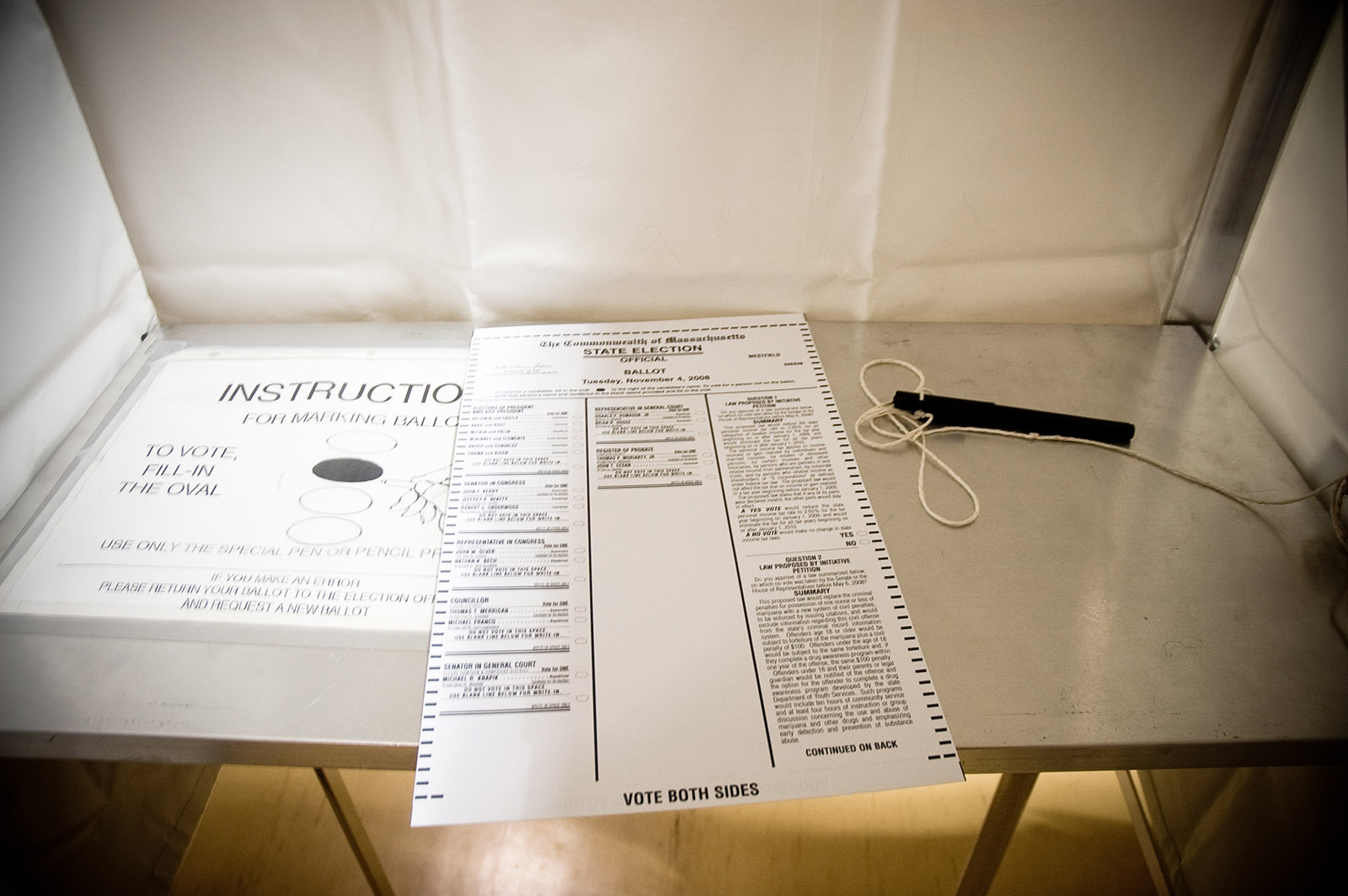

NEW BEDFORD Massachusetts voters face nine statewide questions on Nov. 3, all citizen initiatives, the most on one ballot since 1994. South Coast 360 has explained each one in its own story; this capstone puts all nine side by side, with what a yes and a no vote do on each.
First, the logistics. Election Day is Tuesday, Nov. 3. Most polling places open at 7 a.m. and close at 8 p.m., though towns may open as early as 5:45 a.m., and anyone in line at closing votes. The registration deadline for this election is Saturday, Oct. 24, ten days out; early voting is already underway, having started Oct. 17. Question 4 on this ballot would allow Election Day registration starting in 2028, but it does not apply this year.
Question 1 would put the Legislature and the Governor's office under the public records law every city, town and agency already follows, with carve-outs for policy-development documents and constituent casework. Yes opens most Beacon Hill records; no changes nothing. A Suffolk University poll of 500 registered voters found 83.6 percent in support. Question 2 would let employees of the Committee for Public Counsel Services, the state public defender agency, form a union and bargain collectively, with funding requests then going to the governor within 30 days. Yes grants the right; no keeps current labor law. A Boston Globe poll in mid-October had yes ahead 56.4 to 25.2 percent. Question 3 would replace party primaries for state offices with a single all-party primary whose top two finishers advance to the general election, starting in 2028. Yes adopts the top-two system; no keeps party primaries.
Question 4 would let citizens register at their polling place on Election Day for nearly all elections, starting in 2028, replacing the 10-day advance deadline. Yes allows same-day registration; no keeps the deadline. Question 5 would rewrite Chapter 62F, the 1986 tax-cap law, so refunds trigger more often: the cap would reset each year from actual collections grown by three-year average wage growth, and the millionaires tax surtax would count toward it. The state fiscal office warns it would squeeze the budget and the rainy day fund; the Tufts center projects refunds two to four times as often, averaging roughly $200 to $250 per taxpayer per year. Question 6 would earmark sporting goods sales tax revenue, about $65 million a year, for a Nature for All fund for conservation and recreation, without compelling the Legislature to increase overall spending. Yes creates the earmark; no keeps the money in the general stream.
Question 7 would bar cities and towns from requiring more than 5,000 square feet and 50 feet of frontage for a single-family home on lots with public water and sewer, with towns keeping setbacks, bulk and height rules. The Tufts center projects roughly 750 new homes a year. Yes writes the ceiling into state law; no keeps lot sizes a local matter. Question 8 would repeal retail sales of recreational marijuana while keeping possession of up to an ounce, gifting and medical marijuana legal, and convert the Cannabis Control Commission to medical-only oversight, effective Jan. 1, 2028. The fiscal office counts $280 million in state and $50 million in local revenue at stake. Yes repeals; no keeps the market. Question 9 is a referendum on the 2024 gun law, so it runs backwards: yes keeps the law (ghost gun penalties, wider red flag orders, licensing changes), and no repeals it and restores the pre-2024 rules.
Two patterns run through the nine. Four questions ask voters to override decisions made on Beacon Hill or to end run around them: public records (Question 1), public defender bargaining (Question 2) and the tax cap (Question 5) all reached the ballot after the Legislature declined to act, and the gun law referendum (Question 9) asks voters to undo a law the Legislature passed in 2024. And the money at stake is real even where no question raises taxes: the marijuana repeal puts roughly $330 million in annual state and local revenue in play, the tax-cap rewrite reshapes how much the state can keep in good years, and the conservation question earmarks tens of millions without adding a dollar.
Campaign committees have raised millions around the nine. Among the state campaign finance filings through the Oct. 20 reports: Legalize Starter Homes reported about $1.48 million and the public defender union committee about $1.07 million, while several questions, including Questions 1, 2 and 7, drew no registered opposition committee at all. The state's official guide is posted on the secretary of the Commonwealth's elections site, with the attorney general's summaries, the fiscal statements and both sides' own 150-word arguments for each question.
South Coast 360's explainers, each with the official summary, the fiscal statement where one exists, and both sides in their own words, cover all nine: the all-party primary (Question 3), Election Day registration (Question 4), the tax cap (Question 5), the Nature for All fund (Question 6), starter-home zoning (Question 7), the marijuana repeal (Question 8), the gun-law referendum (Question 9), public records (Question 1) and public defender bargaining (Question 2). However you vote, the registration deadline is Saturday.
Label: Reported by us, from the town's posted records.
Notes
Every figure in this capstone appears, with its primary sourcing and route, in one of the series' nine explainers filed tonight (Q1 through Q9, each with an EVIDENCE file and a verify line); nothing here introduces a new claim beyond the logistics block, confirmed against the state's official 2026 Information for Voters book (the Oct. 24 registration deadline, early voting from Oct. 17, 7 a.m. to 8 p.m. poll hours) and Ballotpedia's Massachusetts voting and 2026 ballot measures pages (the 5:45 a.m. early-opening option, the voter-in-line rule, the nine-most-since-1994 line). The 'four questions override Beacon Hill' framing is the series' own analysis of the documented paths to the ballot. We checked each date and weekday against a calendar (Oct. 24 is a Saturday; Nov. 3 is a Tuesday; Oct. 17 was a Saturday). No committee member names anywhere (house name rule).
Corrections
No corrections to this story. If something here is wrong, tell us. Every correction is dated on the story and listed in our public log.
Sources (3)
- Secretary of the Commonwealth, 2026 Information for Voters (the nine question pages)The official summaries, yes and no statements, fiscal statements and 150-word arguments behind each of the nine one-question paragraphs, as documented in this series' nine explainers and their EVIDENCE files: Q3, Q8 and Q9 read from the pages directly or their Oct. 17, 2026 Internet Archive captures; Q5 and Q6 read directly; Q4, Q7, Q1 and Q2 read from the pages, the petition text on mass.gov, or verbatim reproductions, with each route noted in that story's verify line. Verifier A re-read the official book cover to cover in the verbatim town reproduction (Danvers DocumentCenter 4943) and confirmed the summaries, fiscal statements, arguments, the Oct. 24 registration deadline and the Oct. 17 to 30 early voting window. Read Oct. 21, 2026.
- Center for State Policy Analysis, Tufts University: Voters Guide to 2026 Massachusetts Ballot QuestionsThe independent projections quoted: refunds two to four times as often and roughly $200 to $250 per taxpayer per year on Question 5; the roughly $65 million earmark on Question 6; roughly 750 homes a year on Question 7; the Question 2 bargaining structure and the Question 9 status-quo framing. Read Oct. 21, 2026.
- Ballotpedia: Massachusetts 2026 ballot measuresNine citizen initiatives, the most since 1994; the committee finance figures (Legalize Starter Homes about $1.48 million and the public defender committee about $1.07 million, both through the Oct. 20 reports; no opposition committee on Questions 1, 2 and 7); the Suffolk University Question 1 poll (83.6 percent) and the mid-October Question 2 poll (56.4 to 25.2); and the voting logistics (poll hours, the 10-day registration deadline, early voting), cross-checked against the official guide. Read Oct. 21, 2026.