


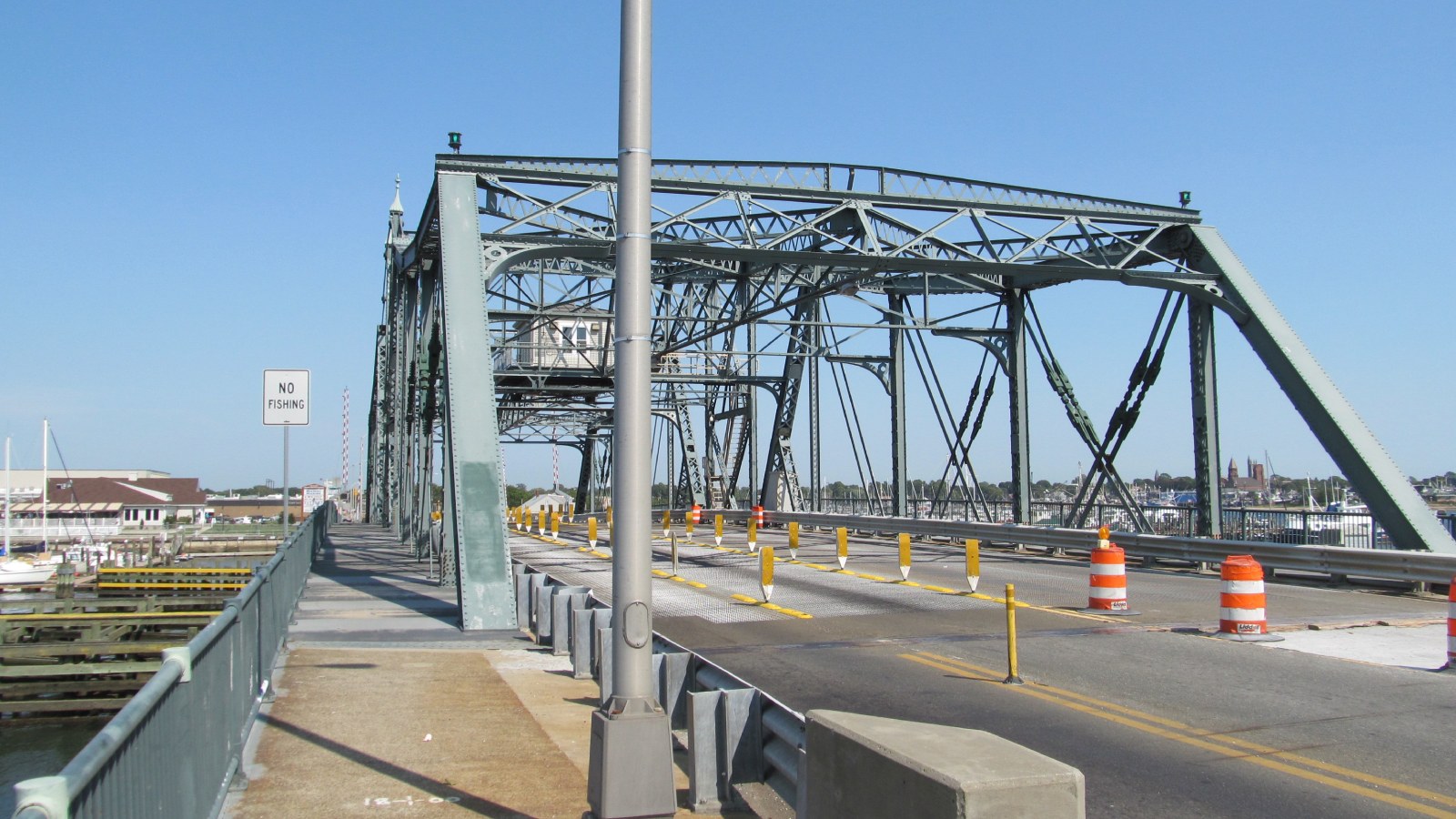

NEW BEDFORD Long before it was a Route 6 traffic question, the bridge between New Bedford and Fairhaven was a toll road, a storm casualty twice over and, by 1899, the "Million Dollar Bridge." The steel swing span over the harbor's main channel swung into place on Oct. 30, 1898.
The Historic American Engineering Record documented the bridge in 1990 and called it a relatively early example of electric power used to move a bridge span, and, at 288 feet, one of the longest surviving swing spans in the state Department of Public Works' care.
A toll bridge and two storms
In 1796 the state General Assembly gave William Rotch of New Bedford the right to build a toll bridge across the Acushnet River. The proprietors, who owned whaling ships, opened a 24-foot-wide bridge in 1800 with two 30-foot draws. Crossing cost 6 cents for a person on foot or a horse, 35 cents for a four-wheeled wagon and 6 cents for a dozen sheep, pigs or cattle.
A wind-driven tide partly wrecked it in 1807, and in September 1815 a hurricane lifted the whole bridge off its piers and broke it apart. A new bridge was finished in 1819 and lasted until another September storm destroyed it in 1869. Bristol County then took the bridge over. The proprietors received $22,838.93, paid by the county, Fairhaven and New Bedford, and the public bridge charged no toll. Horse-drawn streetcars crossed it by 1876 and electric cars by 1893.
Five years of arguments
In 1893 New Bedford's new mayor called on the county commissioners to replace the narrow wooden bridge, and the legislature authorized $200,000. Then came the fights. New Bedford papers accused a Fall River commissioner of steering the contract to cronies, and Fall River papers said New Bedford was making the county pay for a bridge that served only New Bedford. Fairhaven residents argued over where it would land. The War Department insisted that the draw move to the channel between Fish Island and Popes Island, rather than between Fish Island and New Bedford, where it had been since 1800. Wharf owners to the north objected.
With no progress by the end of 1895, the legislature took the project away from the commissioners. Under the agreement that followed, New Bedford's city engineer oversaw construction and the county kept ownership. That engineer, William Fish Williams, was the son of a New Bedford whaling captain and had been born at sea between New Zealand and Tasmania. For the steel draw he brought in George F. Swain of the Massachusetts Institute of Technology, who spent much of the spring of 1897 designing it.
Into place in 1898
Twelve companies bid on the Middle Bridge in June 1897, and the work was split after the first winner would not sign. The Pencoyd Iron Works near Philadelphia built the steel. Crews began setting girders on July 20, 1898, built the swing span in the open position, and on Oct. 30, 1898, it swung into place "with a perfect fit." Williams certified the Middle Bridge complete on March 12, 1899. The 1990 survey found his scrapbook and photographs of the work, including 120 glass slides, in the New Bedford Free Public Library's collection.
By 1899 the bridge had cost more than $1 million, and people started calling it the Million Dollar Bridge. Legislators questioned the county's deal to pay Williams a flat 5% commission and called him to testify. He told them his office and five clerks used up more than half of what he earned, and he was cleared. The last section was finished in 1903. In all, the crossing took 10 years and cost $1,387,261.
Boats, cars and replacement plans
The 1990 survey describes the span turning on a steel drum set on 69 rollers, driven by two electric motors. Boats had priority for openings until 1947, when openings were limited at rush hour and lunch for vessels drawing less than 15 feet. By the late 1960s it opened only on a fixed schedule. In 1990, summer openings came at 15 minutes past each hour.
A state commission found the bridge adequate in 1967 but recommended an eventual elevated replacement. The cost held that off, and a late-1970s revival of the idea died when the money did not come through. In 1987, citing a lack of funding, the state Department of Public Works decided to rebuild the bridge's mechanical and electrical systems instead of replacing it. The bridge had begun sticking open in hot weather, and fire trucks had been called to hose it down so it would close.
Label: Reported by us, from the town's posted records.
Notes
Every fact comes from the Historic American Engineering Record report on the New Bedford-Fairhaven Middle Bridge, HAER No. MA-101, written by HAER historian Patrick Harshbarger in August 1990 and kept by the Library of Congress. The quote is the report's. We read it on Oct. 27, 2026.
Corrections
No corrections to this story. If something here is wrong, tell us. Every correction is dated on the story and listed in our public log.
Sources (3)
- Library of Congress: New Bedford-Fairhaven Middle Bridge, spanning Acushnet River on U.S. Highway 6 (HAER MA-101)Catalog record and significance statement. Read Oct. 27, 2026.
- Historic American Engineering Record, New Bedford-Fairhaven Middle Bridge, written historical and descriptive data (HAER No. MA-101)Patrick Harshbarger, HAER historian, August 1990, for the Massachusetts Historic Bridge Recording Project. Pages 1 to 12: significance and span length, the drum and motors, the 1796 charter, 1800 tolls, the 1807, 1815 and 1869 storms, the county takeover, streetcars, the 1893 to 1896 disputes, Williams and Swain, the 1897 bids, the 1898 erection dates, the 1899 cost and inquiry, the 1903 completion and total cost, the 1947 and 1960s opening rules, the 1967 study and the 1987 repair decision. Read Oct. 27, 2026.
- Wikimedia Commons: New Bedford - Fairhaven Bridge, New Bedford MALead photo: the steel swing span, Aug. 31, 2012, by John Phelan, CC BY-SA 3.0. Read Oct. 27, 2026.