




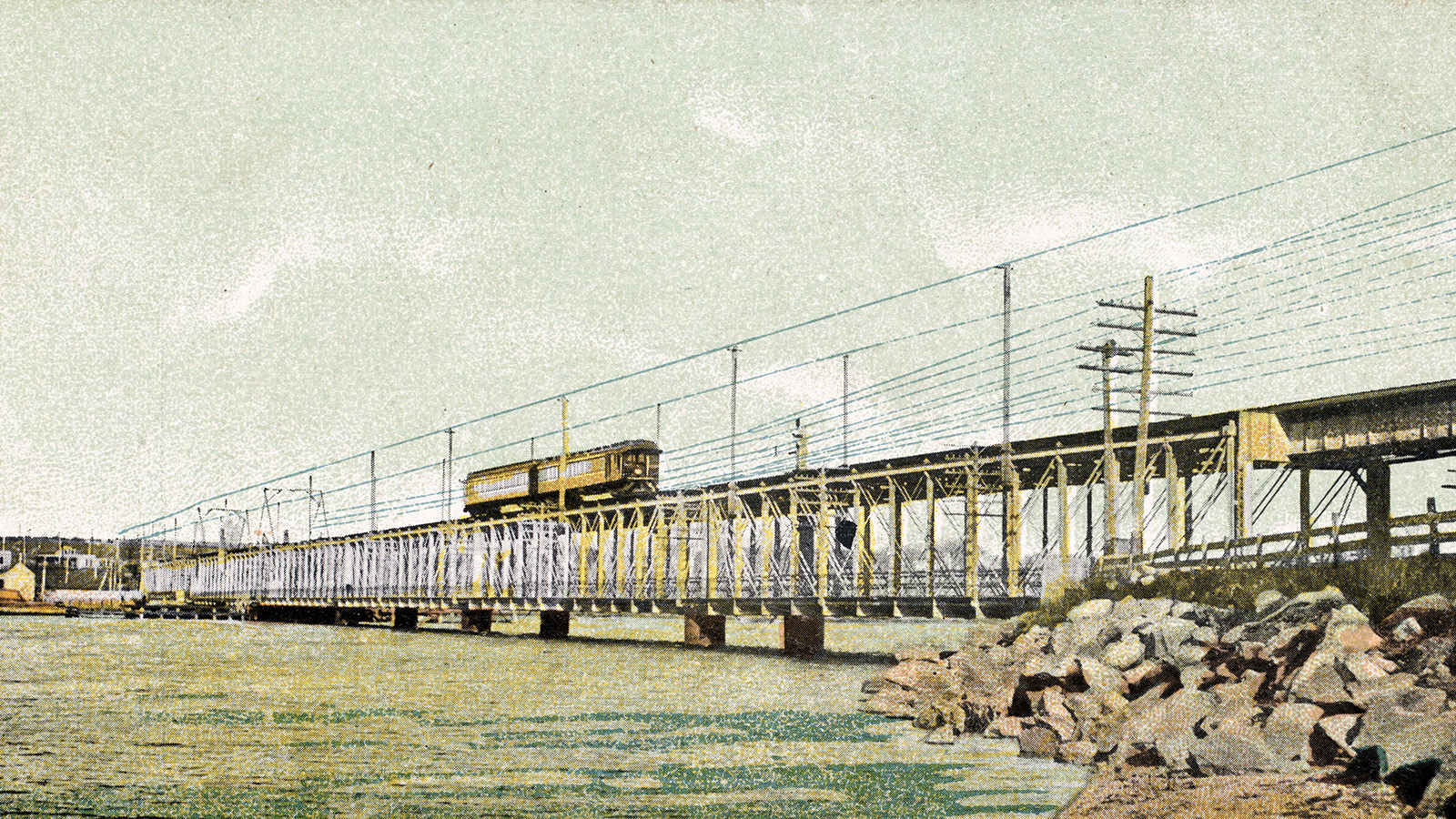
SOMERSET Before there was a bridge, a lamp set in the middle of the ferry house window, on whichever side of the Taunton River a passenger waited, brought the ferry across in the dark.
That is how the Town of Somerset's own history, published by the town in 1940, remembers Slade's Ferry, the crossing between Somerset and Fall River that two families kept running for nearly two centuries. The boats were berthed on the Somerset side at night, so a night boy usually stayed on duty at the Fall River ferry house, the history says, and when the captains went home to supper they stayed home until a voice, a light or, on thick nights, a fog bell called them back.
In 1876 a bridge with two decks took the ferry's place and its name. For close to a century the Slade's Ferry Bridge carried trains, trolleys, wagons and then cars between Somerset and Fall River, with Swansea paying its share, until the state awarded a contract to tear it down in the year that ended June 30, 1970.
Two families, one ferry
The crossing began with neighbors on opposite banks, and on March 20, 1678, Henry Brightman and Thomas Cornell bought a lot in what is now Fall River, directly across from land William Slade had purchased in Shawomet, now Somerset, and Brightman began rowing passengers across for hire, the 1940 history says. In 1680 Slade settled his side and began doing the same.
For two centuries the Slades and the Brightmans each ran the ferry from their own shore, landing at each other's docks without charging any rent, and when bigger boats were needed they split the cost exactly in half. The history describes how it worked aboard the Weetamoe, the last and finest boat of the ferry. Leaving the Brightman slip in Fall River, Capt. Horace Slade took the pilot house while Capt. Cory D. Brightman, "wearing a tall hat," walked the deck and collected the fares. At the Somerset dock the two men traded places, and Slade collected for the trip back. "Neither party to this remarkable arrangement rendered to the other any accounting of receipts," the history says, and the help, the coal and the repairs were paid half and half from each captain's pocket.
From horses on a treadmill to steam
The first boats were rowboats, and a rider's horse had to swim alongside with somebody in the boat holding its bridle, according to the town history. Sail scows came next, and then, on July 22, 1826, the ferry's first horse-boat went into service, built at Saybrook, Conn., for $1,000 and measuring 50 feet by 20. Two horses walked a circular treadmill that turned the paddle wheels, facing opposite directions so the boat could reverse without turning them around.
Steam arrived in 1847 with the Faith, which cost $6,126 fully equipped, and the Slade's Ferry company later ordered the Weetamoe from Fall River shipbuilder Joseph C. Terry for $7,676. "She was the pride of the region and of her owners," the history says, and on rough days, or when ice was tearing at the hulls, the Weetamoe stayed at the dock and the Faith did the work.
A ferry that looked after its neighbors
On the day of the Hood shipyard fire in 1854, the Faith left its run, carried the Fall River fire engine Mazeppa and its crew up the river, stood by while they fought the fire and brought them home again. "It nowhere appears that the ferry proprietors charged for this service," the town history says. During the Civil War, it adds, the proprietors never collected a fare from any Union soldier traveling on furlough. "The Slade-Brightman Ferry was something more than a business. It was a part of the community life and history."
In time the fare for a person reached 10 cents and stayed there for years, no matter who rode or how often, with no round trip prices and no commuter tickets. The schedule County Clerk Simeon Borden approved on Feb. 8, 1866, charged 30 cents for a one-horse rig, 12 cents for a cow and 2 cents for a sheep or a hog, and every fare doubled between 9 p.m. and an hour and a half after sunrise. Circus day was regularly one of the two busiest days of the year, and the elephants, the history says, refused to board the steam ferries and swam across beside them instead.
The waiting rooms on each shore were called shops, about 18 feet square, warmed by a big stove in winter and never closed, and the history recalls them as a popular place for men to gather and talk politics. People could still remember in 1940 that waiting in a line of 50 or more for a place on the boat was a daily experience. One of the outings of the railroad ferry years, the history says, was to cross to Somerset in the morning by Slade's Ferry with a lunch for a day of berrying, or of picking cherries along the shore at Read's Woods Farm, and to come home in the afternoon on the railroad's ferry, the Oriole.
A bridge with two decks
The railroad brought the change, because for eight years the Fall River and Warren line had ended at Brayton's Point in Somerset and handed its passengers to a ferry for Ferry Street in Fall River, the town history says. On May 2, 1872, the Legislature allowed the Old Colony and Newport Railway Company to build a bridge across the Taunton Great River "from some point near Slade's ferry in Fall River, to some point near Slade's ferry in Somerset," made for both highway and railway use. The act put a quarter of the cost on Bristol County, to be shared with the cities and towns that drew a special benefit from it, and it freed the proprietors of Slade's ferry from any legal duty to keep the ferry running once construction began.
Work began on Oct. 8, 1874, according to the city history Henry M. Fenner prepared for Fall River in 1906. The bridge rested on six piers built down to a solid layer 30 to 35 feet below the water, and building it cost lives, with five men killed on Dec. 4, 1874, when the air chamber of an engine burst. When it was ready, teams hauling 95 tons of pig iron rolled across the highway deck at the same moment a train carrying 200 tons of stone crossed the railroad deck above them, the Somerset history says.
Regular trains began crossing on Monday, Dec. 6, 1875, and the railroad's ferryboat Oriole made her last trip the Saturday before, Fenner wrote. The highway deck opened on Tuesday, Jan. 4, 1876, and John S. Brayton and his son, John S. Brayton Jr., were the first to drive across. The bridge was 955 feet long and 20 feet wide, and it cost about $305,000, with Bristol County paying $41,361.20, Fall River $26,000 by Fenner's count and $25,000 by a 1923 state report's, Somerset $5,200, Swansea $3,200 and the Old Colony Railroad most of the rest. Fall River, Somerset and Swansea split the upkeep of the road deck, 74%, 15% and 11%.
"On this latter date, the usefulness of the Slade-Brightman ferry practically ceased," the town history says of Jan. 4, 1876. The Faith's hull was sold and turned upside down into a chicken coop, "one would say the most substantial chicken coop in Fall River's history." The Weetamoe lay idle at her dock for several years, then lost her engines and became a spile driver named the Daisy, which worked the waterfront for many years and lay in plain sight of the bridge until heavy ice crushed her in the winter of 1923 to 1924.
Trolleys, schooners and a tight squeeze
The Globe Street Railway won a franchise to run its cars over the bridge on Oct. 21, 1895, and strengthened the bridge at its own expense, a 1923 state report says. The first electric car crossed on Sept. 4, 1897, according to Fenner, who noted that the street railway had to sell six tickets for 25 cents as the city's condition for letting its cars cross. On the Somerset side, the Dighton, Somerset and Swansea Street Railroad, which the town history says never ran to Swansea in spite of its name, ended at the Somerset end of the bridge, and riders were carried on to Main Street in Fall River by horse-drawn vehicles. Its crews waiting at the Read's Woods turnout picked cherries, the history says, and in the spring of 1907 its rails finally crossed the bridge to Davol Street at the Mechanics Mill.
On the water below, the coal schooners kept coming, and when one was reported coming up the bay, a boat from each shore rowed down the river for the local stores, trying to reach it by the time it came through Slade's Ferry bridge, because the crews usually bought their supplies from the first rower to meet them. The races drew "much sporting interest" from crews and townspeople alike, the history recalls.
In the spring of 1923, the state Departments of Public Works and Public Utilities described a double-deck bridge, with the highway and street railway tracks below and the railroad above, and a draw only 69 feet wide in the clear. Oil tankers bound for a refinery upriver passed through with no more than 18 inches to spare on each side, the report said, and people at the state's hearing said the oil business needed the draw opened about 12 times a day for tugs and barges. The Legislature had authorized a replacement in 1910, and the 1923 board recommended against rebuilding the bridge for highway traffic, since the Brightman Street Bridge, built in 1908 about 1,200 feet upstream, could carry it.
The collision, and a new deck
In the year that ended Nov. 30, 1932, a tank steamer collided with the Slade's Ferry Bridge, the state's Commissioner of Public Safety reported. An emergency law approved on June 29, 1934, directed the Department of Public Works to repair the bridge for highway use, with the New York, New Haven and Hartford Railroad paying toward the work, counting what it had spent "removing the damaged span and cylinders and other wreckage." Once repaired, the bridge would be in the state's charge, with Fall River, Somerset and Swansea still sharing the cost of its upkeep, 74%, 15% and 11%.
Under a 1935 law that divided the cost of the repair a new way, the department signed a contract on Aug. 11, 1937, with Coleman Bros. Corp. of Boston "for reconstructing as a single deck bridge the existing double deck bridge," for a proposal of $224,490, its annual report says, and the same report lists the work as a new draw span, a new floor and general repairs. The bridge kept opening for boats for decades more, and in the fiscal year that ended June 30, 1969, its draw opened 2,699 times, or about seven times a day, the department reported.
The Braga, and goodbye
The new crossing came in 1966, when the Braga Bridge opened, MassDOT says. Its ribbon cutting was on April 15, 1966, NBC 10 reported this spring, and on Easter Sunday just days before, thousands of people walked across it. Elise Duffy, who was 13 and living in Swansea, told the station about walking more than a mile in brand new shoes, then turning around and walking back. "The thing that amazed me the most was how happy everybody was," she said. Her father drove from Swansea to the family's Slade Laundry in Fall River every day, she said, and "the bridge cut out a lot of time for him." The bridge is named for Charles Braga Jr., a Fall River native killed in the attack on Pearl Harbor, NBC 10 reported, and it now carries about 90,000 vehicles a day, MassDOT says.
In the fiscal year that ended June 30, 1970, the Department of Public Works awarded a contract to demolish the Slade's Ferry Bridge, its annual report shows, and NBC 10 has reported that the bridge was removed in 1970. Its upstream neighbor was replaced as well, and the Legislature named the Brightman Street Bridge's successor on Route 6 the Veterans Memorial Bridge in 2009, while the old Brightman Street drawbridge closed in 2011 and still stands in the upright position, NBC 10 reported.
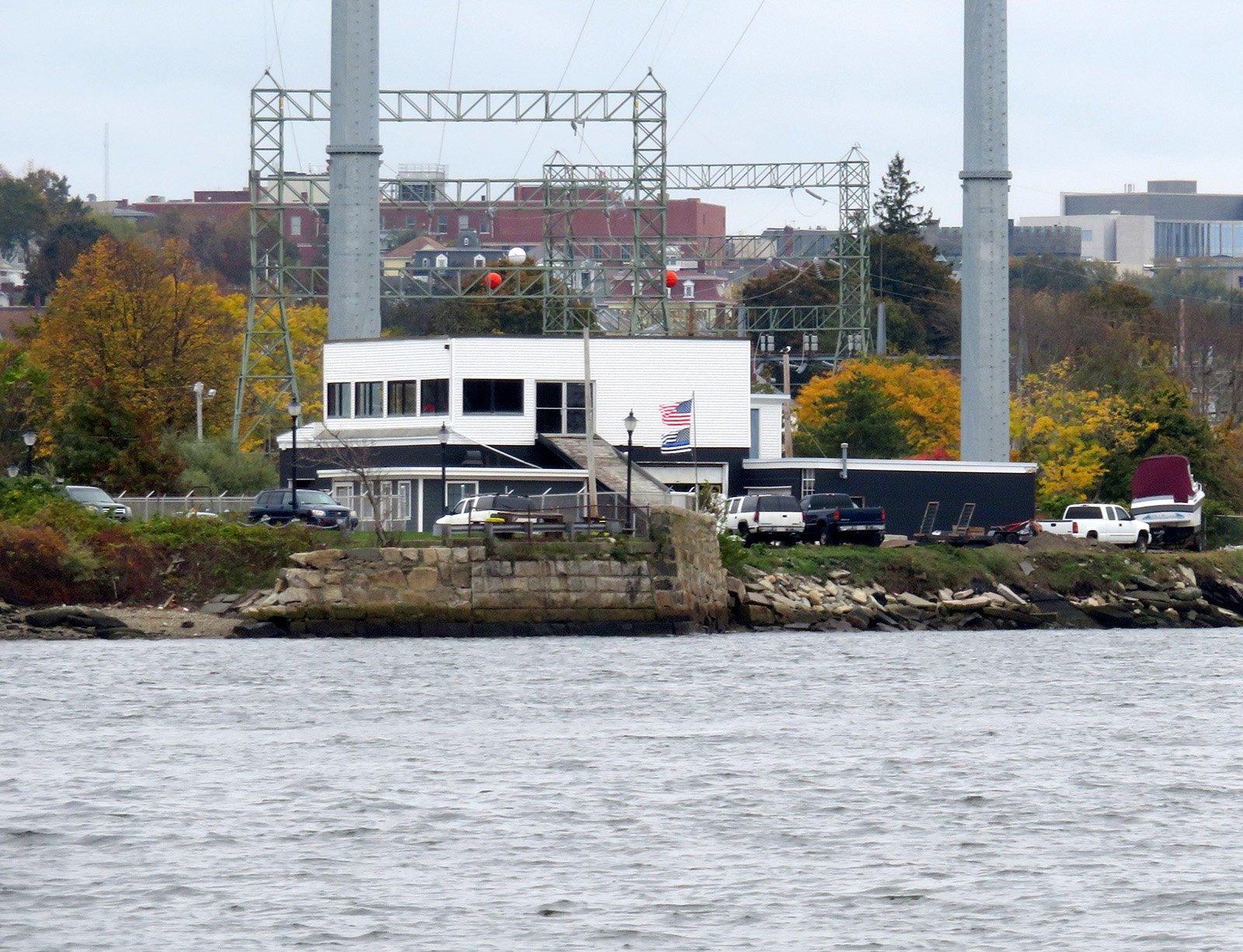

What is left by the water
A low wall of cut stone at the water's edge on the Fall River side, the bridge's east abutment, was still there when a photographer captured it from across the river in October 2020. In 1940 the town history's author, William A. Hart, wrote that it was to the credit of the people of the region that the names of the two ferry families "are perpetuated in the two bridges that take its place." In his day those were the Slade's Ferry Bridge and the Brightman Street Bridge, which, his history notes, rested at both ends on the old slips of the horse-boat ferry.
Did you ever cross the old Slade's Ferry Bridge, ride a trolley over it or wait while the draw opened for a tanker? Send your memories, and any photo of your own, to news@southcoast360.com.
The lamp in the ferry house window went dark long ago and the bridge itself is gone from the river, but as recently as 2020 its old stone still stood on the Fall River shore, a keepsake from the crossing where Somerset and Fall River met in the middle of the river for nearly three centuries.
Label: Reported by us, from the town's posted records.
Notes
Every fact comes from the records, histories and reports in the sources list below, and each is credited in the story. The ferry comes from the Town of Somerset's 1940 history; the bridge's authorization from Chapter 295 of the Acts of 1872; its building, opening, size and cost from Henry M. Fenner's 1906 History of Fall River and the town history; its middle years from a 1923 state report; the 1932 collision from the Commissioner of Public Safety's 1932 report, which gives the year but not the day; the repair from Chapter 367 of the Acts of 1934 and the Department of Public Works' 1937 report, which cites the 1935 law behind the contract; its last draw openings and its demolition contract from the department's 1969 and 1970 reports, which with NBC 10 give the year the bridge came down but not the month; and the Braga Bridge from MassDOT and NBC 10. We read them on Nov. 16, 2026, read them again on Nov. 18, 2026, and checked each date and weekday against a calendar. Where the sources differ, we used the record: Fenner and the 1923 report give slightly different city shares of the cost, so the story gives both, and the two histories describe the bridge's test differently, so the story credits the Somerset history for its account and uses the start of regular train service on Dec. 6, 1875, which both give. Not heard: we did not interview anyone for this piece.
Corrections
No corrections to this story. If something here is wrong, tell us. Every correction is dated on the story and listed in our public log.
Sources (14)
- History of the Town of Somerset, Massachusetts: Shawomet Purchase 1677, Incorporated 1790, by William A. Hart, published by the Town of Somerset, 1940, chapter "Slade's Ferry," pages 125 to 134, and the chapters on the railroad, the coal schooners and the trolley | Allen County Public Library copy, Internet ArchiveThe ferry lamp, night boy and fog bell, the Brightman and Slade purchases of 1678 and 1680, the Weetamoe and her captains, the horse-boat of July 22, 1826, the Faith and the Weetamoe and their costs, the 1854 fire, the Civil War soldiers, fares and the 1866 schedule, the shops, the circus elephants, the lines, the berrying outing, the bridge test, the regular trains of Dec. 6, 1875, the Jan. 4, 1876 opening, the fates of the Faith and the Weetamoe, the schooner races, the 1907 trolley rails and the two bridges line. Read Nov. 16, 2026.
- Acts of 1872, Chapter 295, An Act to Authorize the Construction of a Highway and Railway Bridge over Taunton Great River, and for Other Purposes | State Library of MassachusettsApproved May 2, 1872. The bridge "adapted to both highway and railway purposes," the 60-foot draw, the county's one-fourth share and the release of the ferry proprietors. Read Nov. 16, 2026.
- History of Fall River, prepared by Henry M. Fenner under the direction of a committee of citizens appointed by Mayor John T. Coughlin, F. T. Smiley Publishing Co., New York, 1906 | Internet ArchiveAuthorization May 2, 1872, work begun Oct. 8, 1874, the Dec. 4, 1874 deaths, regular trains Monday, Dec. 6, 1875, the Oriole, the Jan. 4, 1876 opening and the Braytons, length, width, piers, cost and shares, upkeep shares, the first electric car Sept. 4, 1897, and the six tickets for 25 cents. Read Nov. 16, 2026.
- House No. 1504 of 1923, Special Report of the Department of Public Works and the Department of Public Utilities Relative to Slades Ferry Bridge, in the City of Fall River | State Library of MassachusettsDated May 1, 1923. The double deck, the 69-foot draw, the Globe Street Railway franchise of Oct. 21, 1895, the Brightman Street Bridge of 1908, the tankers and 18 inches, the draw openings, the 1910 replacement act and the board's recommendation. Read Nov. 16, 2026.
- Annual Report of the Commissioner of Public Safety for the Year Ending November 30, 1932 (Public Document No. 32) | State Library of MassachusettsThe collision of a tank steamer with the Slades Ferry Bridge at Fall River, page 20. Read Nov. 16, 2026.
- Acts of 1934, Chapter 367, An Act Providing for the Repair, Control and Maintenance of the Slade's Ferry Bridge, So Called | State Library of MassachusettsApproved June 29, 1934, an emergency law; the railroad's payment counting the removal of "the damaged span and cylinders and other wreckage"; state control and the 74, 15 and 11 percent upkeep shares. Read Nov. 16, 2026, with Chapter 358 of the Acts of 1933, which it repealed.
- Annual Report of the Department of Public Works for the Year Ending November 30, 1937 (Public Document No. 54) | State Library of MassachusettsThe contract under Chapter 488 of the Acts of 1935, "an Act reallocating the cost of the repair"; the Aug. 11, 1937 contract with Coleman Bros. Corporation "for reconstructing as a single deck bridge the existing double deck bridge," the $224,490 proposal, and the bridge section's list: new draw span, new floor and general repairs. Read Nov. 16, 2026.
- Massachusetts Department of Public Works, Annual Report, July 1, 1968 to June 30, 1969 | State Library of MassachusettsDrawbridge openings during fiscal 1969: Fall River-Somerset Slades Ferry over Taunton River, 2,699. Read Nov. 16, 2026.
- Massachusetts Department of Public Works, Annual Report, July 1, 1969 to June 30, 1970 | State Library of MassachusettsProjects awarded during fiscal 1970: Slades Ferry Bridge, Fall River-Somerset, contract 14853, demolition. Read Nov. 16, 2026.
- Healey-Driscoll Administration, Local Leaders Celebrate Completion of Braga Bridge Permanent Safety Lighting | MassDOT news release, July 8, 2026, State Library of MassachusettsThe Braga Bridge opened in 1966 and carries about 90,000 vehicles a day. Read Nov. 16, 2026.
- Braga Bridge marks 60 years since opening, linking Fall River and Somerset | NBC 10 News, Mike CerulloPublished April 15, 2026. The April 15, 1966 ribbon cutting, the Easter Sunday walk, Elise Duffy's memories and quotes, the bridge's namesake, the Slade's Ferry Bridge removed in 1970 and the Brightman Street Drawbridge closed in 2011 and still in the upright position. Read Nov. 16, 2026, and again Nov. 17, 2026.
- Acts of 2009, Chapter 140, An Act Designating a Certain Bridge in the City of Fall River and the Town of Somerset as the Veterans Memorial Bridge | Massachusetts LegislatureApproved Nov. 13, 2009: the Brightman Street bridge replacement on Route 6 is the Veterans Memorial Bridge. Read Nov. 16, 2026.
- Fall River, Mass. Slade's Ferry Bridge | Raphael Tuck & Sons postcard No. 5538, Fall River Public Library, Fall River Collection, Historic Postcards, c. 1880 to 1970, Digital CommonwealthLead image. "No known copyright restrictions," licensed CC BY 4.0; date supplied by the cataloger as about 1880 to 1970. Read Nov. 16, 2026, and again Nov. 18, 2026.
- East abutment of Slades Ferry Bridge, October 2020 | Wikimedia Commons, by Pi.1415926535, CC BY-SA 4.0Photo in the story; the file page describes "the remaining east abutment of the Slade's Ferry Bridge, viewed from across the river," taken Oct. 24, 2020. Read Nov. 16, 2026.