


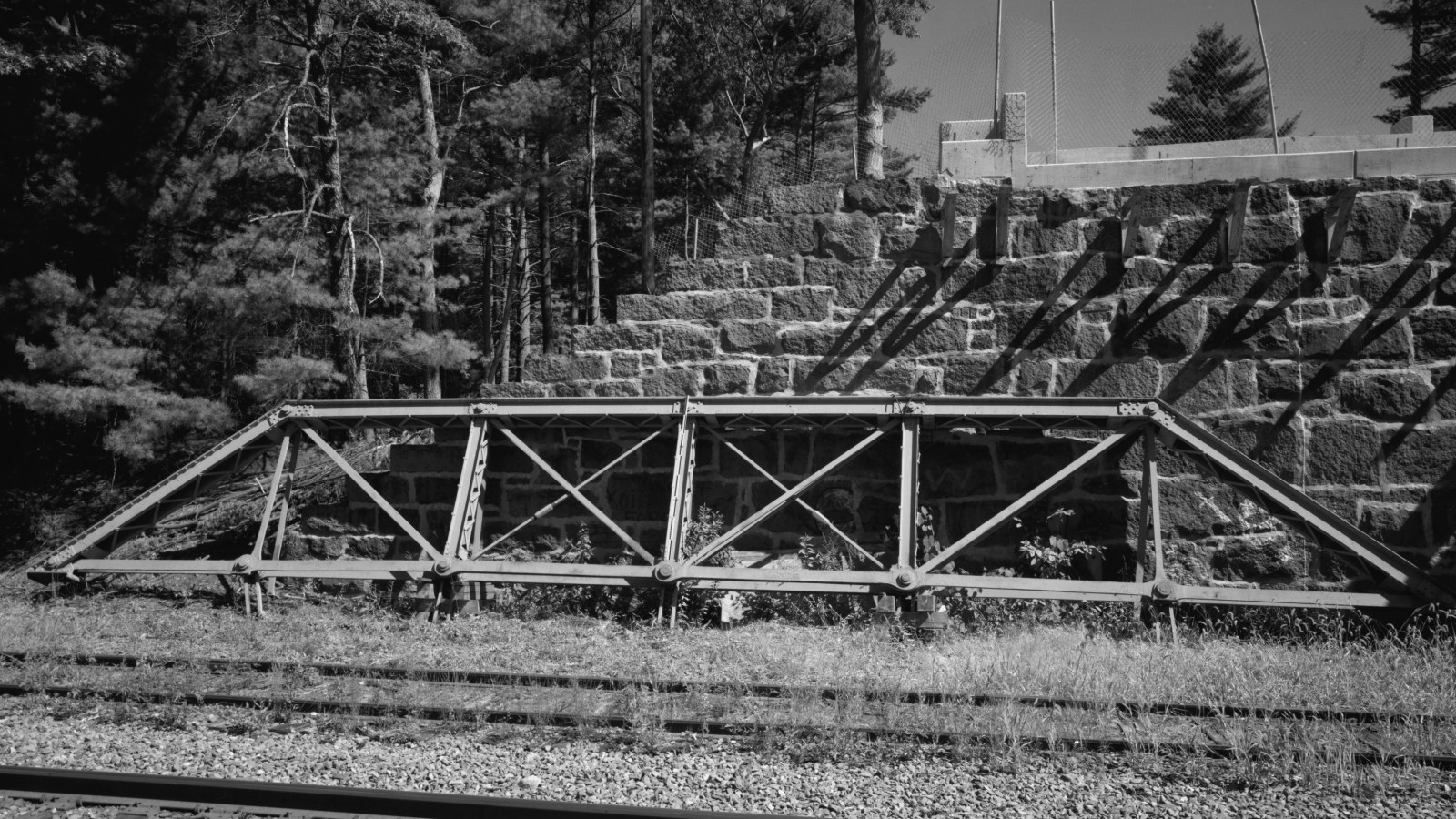
WAREHAM The short iron bridge on Pierceville Road over the railroad tracks in West Wareham has a longer history than its size suggests. A federal engineering survey found that it was built around 1878 by the Keystone Bridge Company of Pittsburgh, a firm Andrew Carnegie organized. Railroad records say it was rebuilt at Tremont in 1887, and it was finished there in 1888.
The Historic American Engineering Record documented the bridge in 1995 and 1996, during a federally funded state rehabilitation, and called it one of the oldest metal truss bridges in Massachusetts. It is also the earliest in the state known to use wide, upset-ended iron eyebars patented by the engineer Jacob H. Linville, a feature that became standard in pin-connected trusses later in the 19th century.
A nail village called Tremont
West Wareham was known as Tremont. In 1822 Col. Bartlett Murdock and George Howland started the Washington Iron Works there, a rolling mill and nail factory with 35 machines. The Tremont Iron Company bought the works in 1845, built a second dam and a nail storehouse beside the railroad, and the small village that grew around them took the Tremont name. In 1858 the iron company sold everything to the Tremont Nail Company, which became known nationally for cut nails. The West Wareham plant was out of service by the late 1920s.
The Cape Cod Branch Railroad, chartered in 1846, ran through West Wareham by 1848 on its way from Middleboro to Sandwich. A branch south to Fairhaven, chartered the next year, was finished in 1854. Tremont Station sat just east of the junction. Both lines became part of the Old Colony Railroad in 1872, and all passenger service on the Old Colony lines ended in 1959.
The 1887 crossing fight
Early in 1887 J.T. Pierce of Rochester asked the Plymouth County commissioners to separate the road from the tracks where Carver Road crossed them at Tremont Station. The railroad wanted the crossing closed and a highway bridge built 20 feet above the tracks. Residents worried about "circuitous travel and much new road making," the nail company worried about its land and mill, and Wareham's selectmen worried about a cost estimated at $15,000 that seemed "likely to fall largely upon Wareham."
On Nov. 15, 1887, the commissioners placed the bridge about 500 feet north of the Carver Road crossing, with rising embankments of about 200 feet at each end, and closed two grade crossings. Special commissioners named by the Superior Court made the railroad build and maintain the bridge, the town build the roads and the county pay land damages. Wareham paid local contractor Charles McDermott $720 for the roads and approaches, and the bridge and abutments were finished in the fall of 1888.
Built for trains, used by cars
New York, New Haven and Hartford Railroad records say the bridge was built in 1878 and rebuilt at Tremont in 1887. Its trusses are much heavier than the road loads of the time called for, and missing and mismatched rivets suggest they were taken apart and moved early on. One theory in the survey is that it began as a railroad bridge somewhere else and was reused after the Bussey Bridge collapse in Dedham on March 14, 1887, which pushed railroads to replace questionable spans.
Each side is a 60-foot wrought iron Pratt pony truss. A founder's mark on the upper chord reads "Union Iron Mill, Pittsburgh, PA," a Carnegie ironworks first known as Carnegie, Kloman & Co. The floor beams were rebuilt in 1945 and the deck was replaced in 1974. When crews took the bridge apart for the 1995 rehabilitation, they found it far more deteriorated than expected, which is what prompted the federal documentation.
Label: Reported by us, from the town's posted records.
Notes
Every fact comes from the Historic American Engineering Record report on the Tremont Station Bridge, HAER No. MA-141, prepared in 1995 and 1996 by historian Lola Bennett and kept by the Library of Congress. It cites Wareham town reports, Old Colony Railroad reports and railroad bridge records. Quotes are from the town's 1888 report as the survey prints them, and from the founder's mark. We read it on Oct. 27, 2026.
Corrections
No corrections to this story. If something here is wrong, tell us. Every correction is dated on the story and listed in our public log.
Sources (3)
- Library of Congress: Tremont Station Bridge, Pierceville Road, spanning Conrail tracks, Wareham (HAER MA-141)Catalog record, significance statement and photographs. Read Oct. 27, 2026.
- Historic American Engineering Record, Tremont Station Bridge (Pierceville Road Bridge), written historical and descriptive data (HAER No. MA-141)Prepared August 1995 to August 1996 by historian Lola Bennett, McGinley Hart & Associates, with photographer Martin Stupich, for the Massachusetts Highway Department rehabilitation. Pages 1 to 10: date and builder, significance, dimensions, founder's mark, 1945 and 1974 repairs, the Washington Iron Works and Tremont Nail Company, the railroad history, the 1887 petition, hearing and decision, cost split, McDermott's contract, the 1878 railroad record, the Bussey Bridge theory, Linville's eyebars and the Keystone Bridge Company. Read Oct. 27, 2026.
- Library of Congress: HAER MA-141-6 photograph of the Tremont Station Bridge west trussLead photo: Martin Stupich for the Historic American Engineering Record, August 1995 (HAER MA-141-6, LOC 384650); no known restrictions on images made by the U.S. Government. Read Oct. 27, 2026.