



SOUTH COAST Ten South Coast cities and towns collected $3.9 million in local marijuana taxes in fiscal 2025, the latest year with reported totals, a tax that would end with adult-use sales on Jan. 1, 2028, if Question 8 passes. One independent analysis puts Question 5 refunds at roughly $200 to $250 a year per taxpayer, averaged over years with and without a refund. Those two questions carry the clearest dollar figures for a household here among the nine statewide questions on Tuesday's ballot. Polls are open until 8 p.m.
The state's voter guide gives each question a yes and a no statement, a cost statement from the Executive Office for Administration and Finance and an argument from each side. Those cost statements find no measurable effect on state or local budgets from Questions 1, 3, 4 and 7. Questions 5, 6 and 8 move money, and Questions 2 and 9 could, in amounts the cost statements do not put a figure on. Each question gets a line from each side's own argument, with local numbers for the 17 communities SC360 covers where a record gives them. Committee totals are what each reported raising in 2026 to the state Office of Campaign and Political Finance through its latest filing; the next reports, covering Oct. 16 to Nov. 1, are due Thursday.
Question 5: the state tax cap and refunds
A yes vote rewrites Chapter 62F, the law that caps how much tax revenue the state may keep. Each year's limit would be built on what the state actually collected the year before, grown by average wage and salary growth, and the surtax on income of more than $1 million would count toward it. Anything collected above the limit would be refunded to taxpayers the following year. A no vote keeps the current formula, which has triggered refunds only twice since it began, according to the Tufts Center for State Policy Analysis. The new formula would apply to state budget years starting July 1, 2027.
The Tufts center estimates that under a yes vote taxpayers would receive roughly $200 to $250 a year, counting years with and without a refund, and that the change would reduce state revenue about as much as an income tax cut of 0.15 to 0.2 percentage points. The administration's cost statement says the measure "would reduce the amount of money available to support the state budget, which includes local aid for schools and municipal budgets," and gives no dollar figure.
The local aid that statement mentions reaches cities and towns through the state's cherry sheets. For the current budget year they put state aid to the 17 cities and towns at $877.5 million before state charges are subtracted, according to the Division of Local Services: $308.6 million to New Bedford, $291.4 million to Fall River, $123.8 million to Taunton, $41.1 million to Plymouth and $1.2 million to $21.7 million to each of the other 13. Question 5's formula would first apply to the state budget year that begins July 1, 2027, so it would not change these current-year figures.
- For: Taxpayers for an Affordable Massachusetts, whose argument says a yes vote "ensures that taxpayers receive refunds when the Commonwealth collects more money than it needs." It reported raising $593,658.
- Against: Protect Massachusetts Future, whose argument says "cities and towns would have to raise property taxes or lay off teachers and firefighters." It reported raising $869,000. Raise Up Massachusetts 2026 and two smaller committees also oppose the question.
Question 8: marijuana stores and the local tax
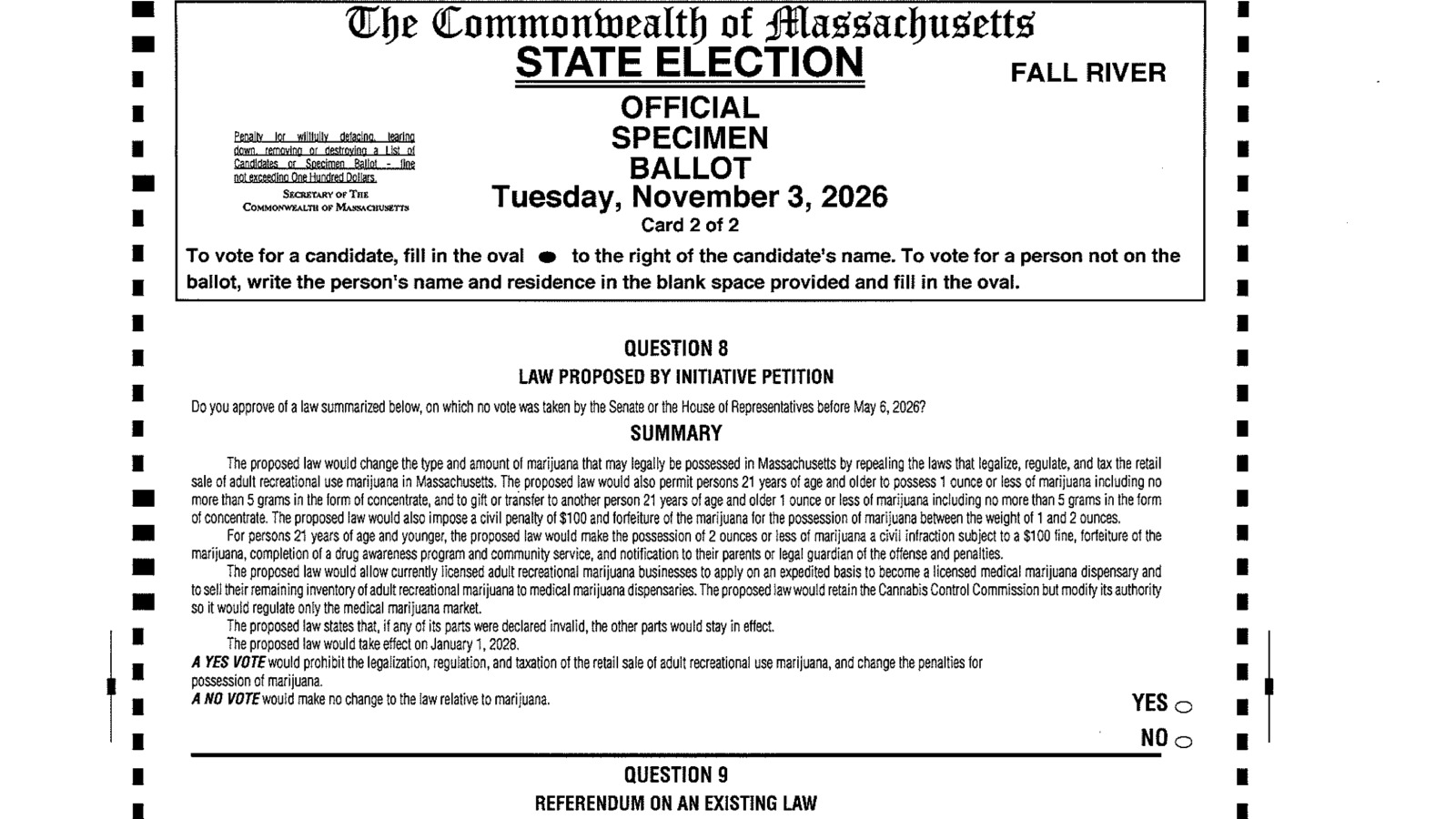
A yes vote ends licensed marijuana sales to adults on Jan. 1, 2028. Medical marijuana stays, adults 21 and older could still possess up to 1 ounce, and having more than 1 ounce up to 2 ounces would bring a $100 civil fine. Licensed adult-use stores could apply on an expedited basis to become medical dispensaries. A no vote keeps the current law.
The administration's cost statement says adult-use sales raised about $280 million in state revenue and $50 million in local revenue in fiscal 2025, and that repeal "would reduce the amount that state and municipal governments receive from the taxation of those sales." The local money is a tax of up to 3% that a city or town may add to sales by marijuana stores inside its borders, under Chapter 64N, Section 3. Question 8 repeals all of Chapter 64N.
Ten of the 17 South Coast communities reported cannabis tax receipts for fiscal 2025, the year that ended June 30, 2025, according to the local receipts they reported to the Division of Local Services. They total $3,911,364. Wareham also reported $19,490 in cannabis impact fees. Acushnet, Freetown, Marion, Mattapoisett, Rehoboth, Rochester and Swansea reported no cannabis tax receipts.
- Fall River: $1,720,694
- Taunton: $554,686
- New Bedford: $470,143
- Wareham: $346,288
- Fairhaven: $255,062
- Plymouth: $163,975
- Somerset: $154,313
- Dartmouth: $144,298
- Dighton: $73,198
- Westport: $28,707
- For: Coalition for a Healthy Massachusetts, whose argument says Question 8 "would keep personal possession of marijuana legal, keep medical marijuana legal, and stop commercial marijuana stores" and that "for every $1 gained in tax revenue, taxpayers spend $4.50 to mitigate the effects of legalization." It reported raising $2,231,835.
- Against: Committee to Protect Cannabis Regulation, which reported raising $2,787,842. The argument against, written for the Massachusetts Cannabis Coalition, says repeal means "returning marijuana to the illicit market where there are no safeguards in place" and that Question 8 "would shut down hundreds of small businesses, kill thousands of jobs, and eliminate billions of dollars in state tax revenue." Three smaller committees also oppose the question.
Question 6: sales tax on sporting goods
A yes vote creates a Nature for All Fund for conservation and outdoor recreation and, subject to the Legislature's yearly appropriation, sends it the state sales and use tax already collected on sporting goods, recreational vehicles and golf courses: half in its first year and all of it after July 1, 2028. The money comes from the existing sales and use taxes. A no vote creates no fund and leaves that money in the general budget.
The administration's cost statement says the measure "would automatically divert tens of millions of dollars of tax receipts that are currently supporting the state operating budget to the new fund" and would carry "substantial implementation costs." The yes side puts the amount at "as much as $100 million/year." Neither the cost statement nor either argument puts a figure on what would reach the South Coast.
- For: Vote Yes for Water and Nature, which reported raising $2,425,569. The argument for, signed by Mass Audubon, says a yes vote "protects water, land, and wildlife in Massachusetts" and does so "without raising taxes."
- Against: No committee is registered to oppose it. The argument against, which the secretary of the commonwealth prepared because no group filed one, says the measure would require "the reallocation or reduction of funds presently directed toward other state initiatives."
Question 7: lot sizes on your street
A yes vote bars local zoning from blocking a single-family home on a lot of at least 5,000 square feet with at least 50 feet of frontage and access to both public sewer and public water, in any district that allows homes. Cities and towns could still regulate height, setbacks, open space, parking and short-term rentals of those homes. A no vote leaves minimum lot sizes to each city and town.
The cost statement finds "no discernible material fiscal consequences" and notes that more housing "could provide positive new growth revenues to municipalities." The Tufts center estimates the change would add roughly 750 homes a year statewide, within a range of 350 to 1,200.
On the South Coast the effect depends on sewer lines, The New Bedford Light reported in March. New Bedford's zoning then required at least 8,000 square feet and 75 feet of frontage for a single-family lot. In Fairhaven, five of the seven districts that allow single-family homes have public sewer, and the smallest minimum among them is 15,000 square feet. Two sewered Dartmouth districts bordering New Bedford require 15,000 and 40,000 square feet. Westport requires 60,000 square feet and would see no change, because it has no sewer system, the Light reported.
- For: Legalize Starter Homes, which reported raising $190,440, and Abundant Housing Legalize Starter Homes, which reported $250,000. The argument for says "Requiring huge lot sizes to build a single-family home makes houses expensive."
- Against: No committee is registered to oppose it. The Massachusetts Municipal Association, which wrote the argument against, says the measure "replaces thoughtful local planning with a one-size-fits-all mandate."
Question 2: a union for public defenders
A yes vote lets employees of the Committee for Public Counsel Services, the state agency that provides lawyers to people who cannot afford one, form a union and bargain with their employer. A no vote leaves the law as it is. The cost statement says the measure "may have an impact on state finances" and that its size is "difficult to project" because the results of any bargaining are unknown.
- For: Labor Unions for Public Counsel Workers Rights, which reported raising $256,000. Its argument says the measure "simply gives CPCS employees the right to make that choice for themselves."
- Against: No committee is registered to oppose it. The argument the secretary prepared says union bargaining "creates serious operational and fiscal risks for the judiciary."
Question 9: keep or repeal the 2024 gun law
Question 9 asks whether to keep the firearms law the Legislature passed in July 2024. A yes vote keeps it; the official statement says the law "increases the regulation of firearms, including ghost guns, machine guns, and assault-style weapons." A no vote repeals it. The cost statement says repeal "would require the Commonwealth to expend resources in suspending or re-directing" what it has spent putting the law in place, with no dollar figure.
- For: Yes for A Safe Massachusetts, which reported raising $720,607. Its argument says a yes vote will "keep in place Massachusetts' lifesaving 2024 gun safety law."
- Against: The Civil Rights Coalition, which reported raising $312,961. Its argument calls the law "an unnecessary reinvention of state firearms law."
Questions 1, 3 and 4: how government and elections work
The cost statements find no measurable effect on state or local budgets from these three. Question 1 would make most records of the Legislature and the governor's office public records starting Jan. 1, 2027; a no vote makes no change to the public records law. Question 3 would replace party primaries for state offices with one primary open to every voter, with the top two finishers moving on to November, starting Jan. 1, 2028; a no vote keeps party primaries. Question 4 would let eligible people register, or update their address, at their own polling place on Election Day starting Jan. 1, 2028; a no vote keeps the deadline 10 days before an election. Question 4 would not apply to Tuesday's election.
- Question 1, for: Committee for Transparency and Democracy, which reported raising $91,221, and the Coalition for Healthy Democracy 2026. The argument for says "the politicians on Beacon Hill exempted themselves."
- Question 1, against: No committee is registered. The argument the secretary prepared says the measure "includes overly broad and poorly defined exemptions."
- Question 3, for: Coalition for Healthy Democracy 2026, which OCPF counts as spending $4,732,954 on this question in 2026. Its argument says "Many elections are over before most of us ever cast a ballot."
- Question 3, against: Voter Rights MA, which reported raising $293,215. Its argument says "Third-party and independent candidates would be shut out of the general election."
- Question 4, for: YES on Election Day Voter Registration, which reported raising $87,630, and Vote YES on 4 Election Day Registration. The argument for calls it "an opportunity voters in the rest of New England already have."
- Question 4, against: No committee is registered. The argument against, written for the Massachusetts Republican Party, says "The public welfare demands that elections be protected from fraud."
Swansea's own question
Swansea voters also decide Question 10, a debt exclusion for a new Joseph Case Junior High School. The town's School Building Committee estimates it would add $141 to $200 a quarter to the property tax bill on the average single-family home if the project spends all of its contingency money, as our Swansea story lays out.
Before you vote
Polls are open until 8 p.m. Each question has its own page with the official summary, the full arguments and the law it changes, starting with Question 5, Question 8 and Question 7, and all nine are listed in our guide. Results for every question and every South Coast race will post on the South Coast 360 Election Center after polls close.
Label: Reported by us, from the town's posted records.
Notes
Every fact comes from the Secretary of the Commonwealth's 2026 Information for Voters guide, the state Office of Campaign and Political Finance's ballot question data, the Division of Local Services' local receipts and cherry sheet reports, state law, Somerset's election page and the Tufts Center for State Policy Analysis voter guide, listed below; the Swansea Question 10 estimate is the town School Building Committee's, as reported in our verified Swansea story; the lot-size figures are The New Bedford Light's reporting, credited. We read them on Nov. 2 and Nov. 3, 2026. The arguments and the figures in them are each side's own. SC360 takes no position on any question. We checked each date and weekday against a calendar.
Corrections
No corrections to this story. If something here is wrong, tell us. Every correction is dated on the story and listed in our public log.
Sources (9)
- Secretary of the Commonwealth: 2026 Information for Voters (the state voter guide mailed to every household)Yes and no statements, the Executive Office for Administration and Finance statements of fiscal consequences and the arguments for and against all nine questions, quoted word for word from the printed book (IFV_2026_English.pdf, saved Oct. 19, 2026). Read again Nov. 3, 2026.
- Office of Campaign and Political Finance: 2026 ballot question committees by question2026 receipts for every committee registered for or against each question, from reports through Oct. 15; next reports, covering Oct. 16 to Nov. 1, due Nov. 5 under OCPF's filing calendar (01-2026-BQ1105). Read Nov. 3, 2026, 7:10 a.m.
- Division of Local Services: Local Receipts, Actual vs Estimate (Tax Rate Recap, page 3)Fiscal 2025 actual cannabis excise and cannabis impact fee receipts for the 17 South Coast communities. Read Nov. 3, 2026.
- Division of Local Services: State Aid, Cherry SheetFiscal 2027 state aid receipts, charges and net aid for the 17 South Coast communities. Read Nov. 3, 2026.
- General Laws, Chapter 64N, Section 3: Local tax optionThe local tax of up to 3% on marijuana retail sales. Read Nov. 3, 2026.
- Center for State Policy Analysis, Tufts University: Voters Guide to 2026 Massachusetts Ballot QuestionsQuestion 5 refund estimate of roughly $200 to $250 a year per taxpayer and the two refunds since Chapter 62F began; Question 7 estimate of roughly 750 homes a year (range 350 to 1,200). Read Nov. 2, 2026.
- The New Bedford Light: Ballot push seeks to 'legalize starter homes' statewide (March 3, 2026)Credited for the lot-size minimums and sewer facts it reported for New Bedford, Fairhaven, Dartmouth and Westport. Read Nov. 3, 2026.
- South Coast 360: Swansea voters decide 10 ballot questions Nov. 3 (published Oct. 21, verified Oct. 31, 2026)The Swansea School Building Committee's estimate of $141 to $200 a quarter for the average single-family home on Question 10, from its Sept. 16 forum table. Read Nov. 3, 2026.
- Town of Somerset: 2026 State Election, Nov. 3, 2026Election Day polling location: Somerset Berkley Regional High School, Student Dining Hall, 625 County St. (photo caption). Read Nov. 2, 2026.