




NEW BEDFORD On Nov. 14, 1851, Harper & Brothers published "Moby-Dick; or, The Whale" in New York. Its author had learned whaling on a ship from across the harbor: the Acushnet of Fairhaven, which sailed for the Pacific on Jan. 3, 1841, with Herman Melville, 21, in her crew. The novel turns 175 on Nov. 14. Part of what visitors see today at the Seamen's Bethel in New Bedford came from the book and from a 1956 film.
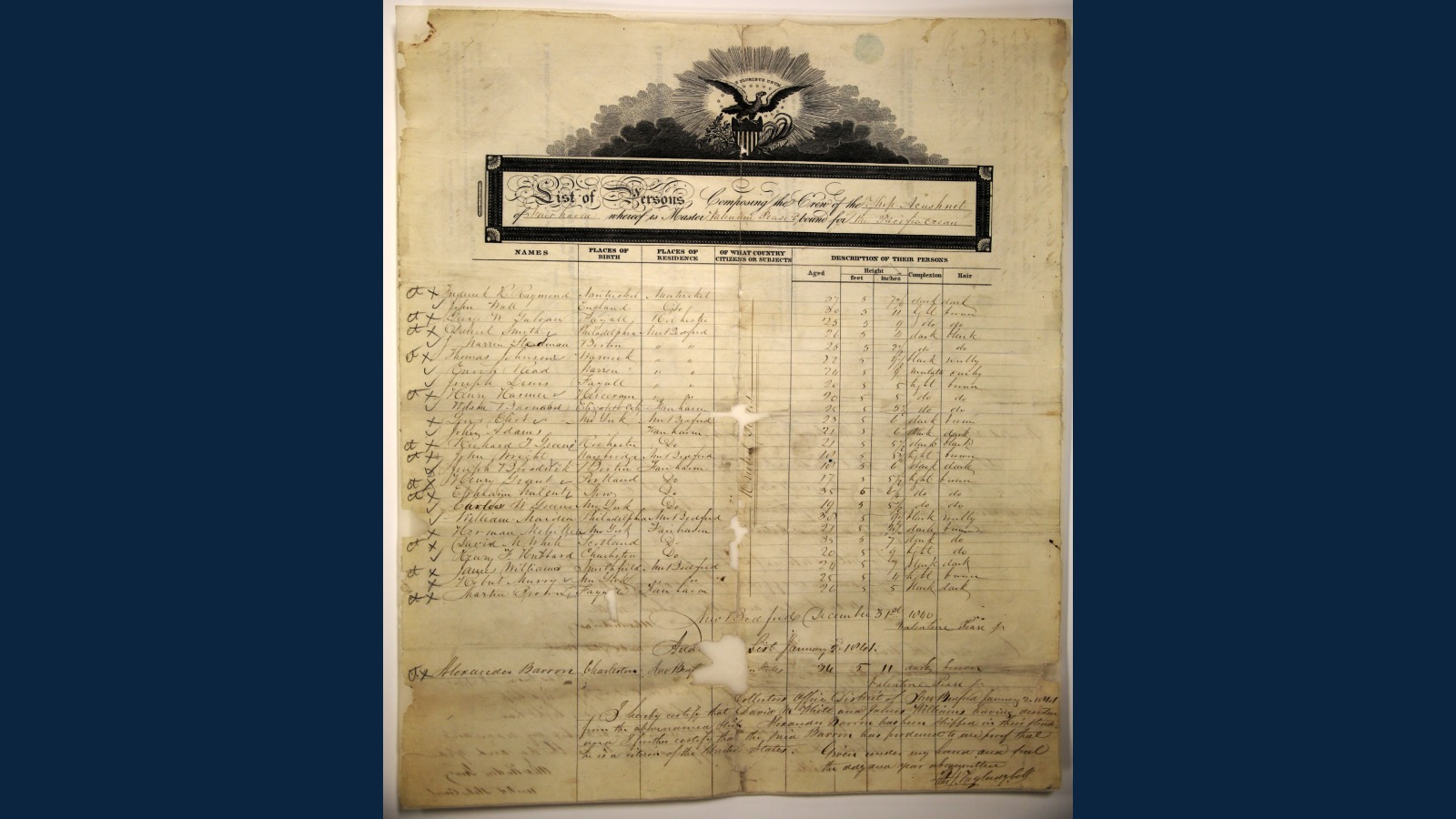
Sixth name from the bottom
The crew list is one printed form under an engraved eagle, filled in by hand: "List of Persons Composing the Crew of the Ship Acushnet of Fairhaven whereof is Master Valentine Pease Jr. bound for the Pacific Ocean." Pease signed it at New Bedford on Dec. 31, 1840. Melville's line says he was born in New York and lived in Fairhaven, and lists him as 21, 5 feet 9 and a half inches tall, with a dark complexion and brown hair. Higher on the same page is Richard T. Greene, also 21, the shipmate who would later walk away from the ship with him.
On Jan. 2, 1841, the collector of customs at New Bedford added a certificate at the bottom: David M. White and James Williams had deserted, and Alexander Barron had been shipped in their place. Under an 1803 act of Congress for merchant ships bound for foreign ports, the collector kept a copy, according to the National Archives, which holds it at the National Archives at Boston in Waltham and posts a scan of every page in its online catalog.
The ship and the voyage
The Acushnet was a new ship of 359 tons, built in Mattapoisett in 1840 by Gideon Barstow & Son and sent out by the agents Bradford, Fuller & Co., according to the American Offshore Whaling Voyages database, which the New Bedford Whaling Museum keeps with the Nantucket Historical Association and Mystic Seaport Museum. The database and the National Park Service give her sailing date as Jan. 3, 1841, while the National Archives catalog and Arthur Stedman, in an 1892 introduction to Melville's first book, give Jan. 1. The crew list itself was amended at New Bedford on Jan. 2. The database records her return in 1845 with 850 barrels of sperm oil, 1,350 barrels of whale oil and 13,500 pounds of whalebone.
By that homecoming Melville was long gone, after 18 months aboard, the National Archives says. When the ship had rounded Cape Horn and crossed the Pacific, he and another crewman deserted in July 1842 while she lay at Nukahiva in the Marquesas Islands. Eleven of the original 26 officers and men deserted at various times during the voyage, the archives notes.
He turned the weeks that followed into his first book, "Typee," published in 1846. Stedman's 1892 introduction called it the record of "Melville's escape from the Dolly, otherwise the Acushnet," and of his companion Toby, who, Stedman wrote, was "an authentic personage, by name Richard T. Greene," the same name that is written on the Fairhaven crew list. The Acushnet herself was stove by a whale in 1847 and lost on Aug. 16, 1851, the whaling database records, three months before the American edition of the novel came out.
On a Saturday night in December
The narrator, Ishmael, takes Melville's road as far as New Bedford. "I duly arrived in New Bedford," he says in Chapter 2 of the 1851 edition. "It was on a Saturday night in December." He has missed the packet to Nantucket and must wait until Monday. In Chapter 6 he writes that "nowhere in all America will you find more patrician-like houses; parks and gardens more opulent, than in New Bedford," and he says where the money came from: "One and all, they were harpooned and dragged up hither from the bottom of the sea."
Chapter 7 opens on the chapel, and on Ishmael's Sunday visit to it: "In this same New Bedford there stands a Whaleman's Chapel, and few are the moody fishermen, shortly bound for the Indian Ocean or Pacific, who fail to make a Sunday visit to the spot." Ishmael reads the marble tablets on its walls for men lost at sea and gives three of them, though he warns, "I do not pretend to quote." When he and Queequeg leave, their schooner "glided down the Acushnet river," past wharves where "huge hills and mountains of casks on casks were piled." The ship he signs onto, the Pequod, he finds in Nantucket, and the novel's voyage starts from that island. In Chapter 24, Ishmael credits the trade: "a whale-ship was my Yale College and my Harvard."
Record and legend at the Bethel
The chapel in the book is the Seamen's Bethel on Johnny Cake Hill. Town citizens organized the New Bedford Port Society for the Moral Improvement of Seamen in 1830, and in 1832 it dedicated the Bethel as a nondenominational church, which it still is, according to the National Park Service. Melville attended services there between his arrival in late December 1840 and the day he sailed, the Park Service says, and the pew he sat in, in the southeast corner, is marked for visitors. The tablets on its walls are real cenotaphs, put up by families who had no grave to visit, and many say how the men died.
The pulpit, though, is where the record and the legend part. Melville described one reached by a ship's side ladder, with a "panelled front" made "in the likeness of a ship's bluff bows." The Park Service says the pulpit Melville saw was most likely a typical New England box pulpit and that the bow came from his imagination. Visitors went looking for it, the Park Service says, after John Huston's 1956 film, which showed the pulpit as a ship's prow and was shot in Ireland. After years of complaints the Port Society built a mock-up, which visitors first saw in 1961, and it has stayed. The Port Society's own history says the service Melville attended in 1840 inspired the Father Mapple sermon in the novel.
Two first editions
The book, which the Park Service says Melville wrote at his home in Pittsfield, came out twice in 1851. Richard Bentley published it in London on Oct. 18 as "The Whale," in three volumes and only 500 copies, according to the Library of America and Smithsonian magazine. After sending his corrected proofs to London, Melville decided to call the book "Moby-Dick" and dedicate it to his friend Nathaniel Hawthorne, the Library of America says, and the word reached Bentley in time for the dedication but not the title. Bentley also left out the Epilogue, in which Ishmael tells how he survived, and scholars count about 600 differences in wording between the two editions.
Harper's American edition followed on Nov. 14, under the new title. A Duke University Libraries copy, scanned for the Internet Archive, carries the imprint "New York: Harper & Brothers, Publishers. London: Richard Bentley. 1851." and the dedication "In token of my admiration for his genius, this book is inscribed to Nathaniel Hawthorne."
In his letters to Hawthorne, Melville followed the book through the press. "The 'Whale' is only half through the press," he wrote from Pittsfield on June 29, 1851. In another letter, printed after it without a date, he said he would soon go to New York "to bury myself in a third-story room, and work and slave on my 'Whale' while it is driving through the press," and he wrote, "Dollars damn me." Julian Hawthorne printed both letters in 1884 in his biography of his parents.
Melville in New Bedford today
New Bedford added a Melville landmark this summer: on Aug. 14, the city unveiled a statue of Melville by sculptor Steff Rocknak beside the Seamen's Bethel, showing him rising out of a sweeping wave and holding a whale bone, Cape and Islands NPR reported. NBC 10 had reported the city's plan to dedicate the statue there at 11 a.m. that day.
The New Bedford Whaling Museum's virtual Moby-Dick Book Club takes up Chapter 91 through the Epilogue on Nov. 17 at 5:30 p.m., with registration on the museum's site. The museum's 31st Moby-Dick Marathon, which it says commemorates Melville's 1841 departure on the Acushnet, runs Jan. 8 to 10, 2027. The 25-hour reading begins at noon Jan. 9 at the stern of the museum's Lagoda with "Call me Ishmael," and Father Mapple's sermon is read at the Seamen's Bethel at 1:30 p.m. that day, with seats by lottery and a livestream. The reading ends at 1 p.m. Jan. 10.
The Port Society lists the Bethel, at 15 Johnny Cake Hill, as free and open to the public Tuesday through Sunday, 11 a.m. to 3 p.m., and says hours may vary on holidays and during special events.
Read it yourself
- The Acushnet crew list is in the National Archives Catalog as "Crew List and Consular Documents for the Whaler Acushnet," with a scan of each page.
- Duke University Libraries' copy of the first American edition is a free scan on the Internet Archive.
- Melville's two letters, the first dated June 29, 1851, begin on page 398 of Julian Hawthorne's "Nathaniel Hawthorne and His Wife," Volume 1 (1884), also on the Internet Archive.
The Acushnet's first voyage also appears in our whaling series, South Coast whaling beyond New Bedford. For more South Coast history, read our Specials on Joshua Slocum and the Spray in Fairhaven and Hetty Green, the New Bedford whaling heiress.
Label: Reported by us, from the town's posted records.
Notes
The crew details come from the Acushnet's crew list itself, read on the National Archives' scan, and the desertions, the 18 months aboard and the 1803 act from the National Archives. The ship, her voyage and her loss come from the American Offshore Whaling Voyages database. Every quote from the novel was checked against the 1851 Harper first edition, and Melville's letters against the page images of the 1884 book that printed them. The Bethel history comes from the National Park Service and the New Bedford Port Society, the two 1851 editions from the Library of America and Smithsonian magazine, the statue from Cape and Islands NPR and NBC 10, and the coming events from the Whaling Museum's own program pages. The records disagree on the sailing date: the story gives Jan. 3 from the whaling database and the Park Service and notes the Jan. 1 date in the National Archives catalog and an 1892 account. Melville's age, 21, is the one written on the crew list. We read them on Oct. 31 and checked each date and weekday against a calendar. Not heard: no one was contacted.
Corrections
No corrections to this story. If something here is wrong, tell us. Every correction is dated on the story and listed in our public log.
Sources (14)
- Crew List and Consular Documents for the Whaler Acushnet (NAID 81143298), Records of the U.S. Customs Service, Crew Lists of Whaling Vessels | National Archives CatalogPage 1 scan read in full: the printed heading, every crew line, Pease's Dec. 31, 1840, signature at New Bedford and the collector's Jan. 2, 1841, certificate; catalog scope note dating the departure Jan. 1, 1841; catalog note on secure storage and the Talcahuano and Sandwich Islands consular papers. Read Oct. 31, 2026.
- "A Voyage into History," Prologue, Fall 2009, Vol. 41, No. 3 | National ArchivesNov. 14, 1851, U.S. publication; 18 months aboard; desertion at Nukahiva in July 1842; 11 of 26 deserted; the 1803 act; the list held in Waltham. Read Oct. 31, 2026.
- American Offshore Whaling Voyages: A Database (6/19/2026 build) | New Bedford Whaling Museum, Nantucket Historical Association, Mystic Seaport MuseumVoyages AV00209 to AV00211 of the ship Acushnet (AS0819): tonnage, builder, agent, Jan. 3, 1841, sailing, 1845 return and catch, master's birth, "Stove by a whale, 1847; lost Aug 16, 1851." Units from the column definitions page. Read Oct. 31, 2026.
- Herman Melville, Moby-Dick; or, The Whale (New York, Harper & Brothers; London, Richard Bentley, 1851), first American edition | Internet Archive (Duke University Libraries copy)Title page, copyright page and dedication read on the page images; Chapters 2, 6, 7, 8, 13, 16 and 24 read in the scan text for every quote. Read Oct. 31, 2026.
- Julian Hawthorne, Nathaniel Hawthorne and His Wife, Volume 1 (Boston, Houghton, Mifflin, 1884) | Internet ArchiveMelville's letter of June 29, 1851, and the undated letter after it, pp. 398 to 403, quotes checked on the page images of pp. 399, 400 and 402. Read Oct. 31, 2026.
- Herman Melville, Typee, with Arthur Stedman's introduction to the 1892 edition | Project GutenbergStedman on "the Dolly, otherwise the Acushnet" and on Toby as Richard T. Greene; Stedman's Jan. 1, 1841, sailing date; the book dated 1846. Read Oct. 31, 2026.
- Seamen's Bethel | New Bedford Whaling National Historical Park, National Park ServiceThe Port Society's founding in 1830, dedication in 1832, Melville's attendance and marked pew, the cenotaphs, the box pulpit, the 1956 film shot in Ireland and the 1961 mock-up. Also read the park's Bethel visit page and Herman Melville page (Jan. 3, 1841, sailing; Pittsfield). Read Oct. 31, 2026.
- Seamen's Bethel | New Bedford Port SocietyThe Port Society's history and timeline, including its account of Melville's 1840 service and Father Mapple; hours and address from its visit page. Read Oct. 31, 2026.
- "October 18, 1851: Melville's Moby-Dick is published in London as The Whale" | Library of AmericaBentley's Oct. 18 London edition of 500 sets, the late title change and dedication, the missing Epilogue, about 600 differences. Read Oct. 31, 2026.
- Discover the origins and early criticism of Herman Melville's great American novel, Moby-Dick | Smithsonian magazineOct. 18 London and Nov. 14 New York dates, three volumes, 500 copies, the Epilogue, about 600 differences. Harper's 2,915 copies. Read Oct. 31, 2026.
- "Sculptor of new statue in New Bedford 'always thought Melville was handsome'" | Cape and Islands NPR, Aug. 18, 2026The unveiling on Friday, the statue beside the Seamen's Bethel, Steff Rocknak, the wave and the whale bone. Read Oct. 31, 2026.
- "New Bedford to dedicate Herman Melville statue at Seamen's Bethel" | NBC 10 (WJAR), July 29, 2026City plan to dedicate the statue at the Seamen's Bethel on Aug. 14 at 11 a.m. Read Oct. 31, 2026.
- Moby-Dick Book Club | New Bedford Whaling MuseumVirtual series, Marina Wells moderating; Tuesday, Nov. 17, at 5:30 p.m., Chapter 91 to the Epilogue. Read Oct. 31, 2026.
- Moby-Dick Marathon 2027 | New Bedford Whaling Museum31st marathon, Jan. 8 to 10, 2027, commemorating the 1841 Acushnet departure; noon start Jan. 9 at the Lagoda; Father Mapple's Sermon at the Seamen's Bethel at 1:30 p.m., lottery seating and livestream; ends 1 p.m. Jan. 10. Read Oct. 31, 2026.