




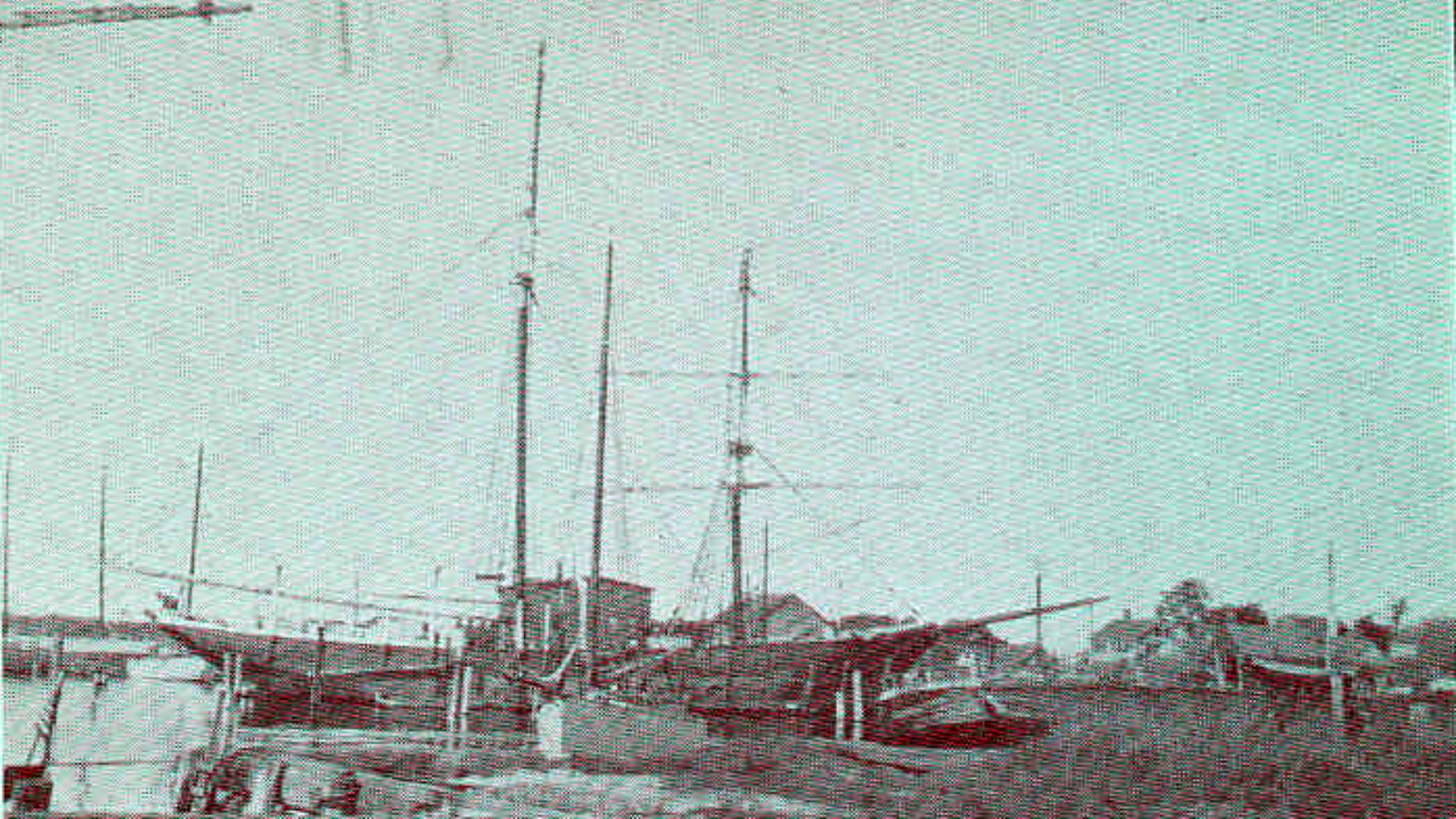

Fairhaven sent 576 whaling voyages to sea, the seventh most of any American port, according to the American Offshore Whaling Voyages database kept by the New Bedford Whaling Museum, Mystic Seaport Museum and the Nantucket Historical Association. Part 1 of this series mapped the whole South Coast fleet. This part stays on the east bank of the Acushnet River, where the town grew up around try works, shipyards and a harbor fort, and where the Civil War ended the trade.
Two villages and a try works
Before Fairhaven was a town it was two villages. On Dec. 12, 1760, William Wood deeded six acres at the Point to Elnathan Eldridge, land that came to be called Oxford, but kept back the try works and oil sheds at its southeast corner, according to the history the town's Old Home Week committee published in 1903. The committee wrote that the people of both settlements, Oxford and the upper village called Fairhaven, "were engaged in the whale fishery."
Oxford seems to have been where the first vessels were built. After the toll bridge to New Bedford went up in 1796 and 1797, the committee wrote, shipbuilding moved below the bridge, and the last vessels built in town came off Blackler's shipyard, just north of the American Tack Co. works. Fairhaven itself was part of New Bedford until it was set off as its own town on Feb. 22, 1812, according to the published vital records of New Bedford. The committee recorded that the northern part of town, past Dahl's Corner, split away again as the town of Acushnet on Feb. 13, 1860.
The fort that rose twice
Work on a fort at Nolscot Point began early in 1775 under Capt. Benjamin Dillingham and took two years, the 1903 history says. By 1778 it held 11 iron cannon and a garrison of 32 men under Capt. Timothy Ingraham. A marker at the fort gives the same building years and the same 11 guns.
British troops landed at Clarks Cove on Saturday, Sept. 5, 1778, burned their way up the New Bedford side to the head of the river and came down the Fairhaven side, according to the town history. On the evening of Sept. 6 they landed north of the fort and began to burn the village. Several hundred minutemen under Maj. Israel Fearing met them and drove them off, the committee wrote, but the retreating troops burned the barracks, spiked the guns and wrecked the fort.
The fort was rebuilt quickly: the town history says it was garrisoned again by May 19, 1780, and a deed of March 2, 1784, already speaks of "the point called Nolscot on which Fort Phoenix now stands." The marker at the site says the name came from the mythical bird that rose from its own ashes.
The palmy days
The database shows only a handful of Fairhaven sailings a year until the late 1820s. Then the town's fleet took off: 16 voyages sailed in 1831, 19 in 1833 and 23 in 1838, the busiest single year. The 1903 committee called 1830 to 1857 the palmy days and put the peak in 1854, when "it is reported, some fifty vessels" were sailing from Fairhaven. The database agrees: 50 different Fairhaven vessels sailed or were at sea that year.
In all, 129 vessels sailed for Fairhaven owners. The ship Herald made the most voyages from the town, 26, followed by the Heroine with 18 and the Amazon with 17. The voyages that recorded a catch brought home at least 328,591 barrels of sperm oil, 526,276 barrels of whale oil and more than 5 million pounds of whalebone.
Banks and insurers grew up around the trade. The Fairhaven Bank was chartered on March 18, 1831, with $100,000 in capital, and the Fairhaven Insurance Company two days earlier with the same, according to the 1903 history, which notes that the insurance company went out of existence with the decline of whaling. On Fort Street the Rodman property held large stone buildings for making spermaceti candles and a stone wharf built for the largest whaling ships.
Wives at sea
A captain's wife sailed aboard on 38 Fairhaven voyages, the database records. The earliest is the ship Arab in 1821, when Capt. Stephen Gibbs sailed with his wife, Louisa Fearing. Most came in the 1850s, among them Phebe A. Derickson, who sailed with Capt. John Charry on the bark Harvest in 1857, on what turned out to be the Harvest's last whaling voyage.
Sunk for the Union
The Harvest came home in 1861, the year the war began. Owners sold or laid up their ships rather than risk Confederate raiders, and the federal government bought 40 of them for the two Stone Fleets it sank off Charleston and Savannah in 1861 to block the harbors, Alexander Starbuck wrote in his 1878 history of the American whale fishery. His list of the first Stone Fleet includes three Fairhaven vessels: the Amazon, the Harvest and the Rebecca Sims. The database gives the same end for all three. The Amazon, built at Berkley in 1815, had made 17 Fairhaven voyages between 1821 and 1856.
The captain of the Favorite
The bark Favorite first sailed from Fairhaven in 1828 and made 15 voyages from the town. In late June 1865 she was one of nine whalers the Confederate raider Shenandoah captured in a single morning in the Bering Strait, Starbuck wrote. The database records her burned south of the Diomede Islands on June 28.
Her captain, Thomas G. Young, was "a man between sixty and seventy years of age" and a part owner of the ship, according to Starbuck. He loaded his bomb guns and firearms, climbed onto the cabin roof and ordered the raider's boarding officer to "stand off." While he waited, his own officers took the caps off his guns and left in the boats. When a second boat came, Young pulled the trigger and nothing happened. Starbuck wrote that the raiders put him in irons and took his money, his watch and his shirt studs.
The schooner Kingfisher of Fairhaven had already been taken and burned by the raider Alabama in 1863, the database shows. The town committee wrote in 1903 that the raiders destroyed "some 46 whaling vessels, several of them belonging to this town," and that "from this serious blow to a profitable industry, Fairhaven never recovered." The database lists the town's last three whaling voyages in 1876.
From oil to tacks
In 1864 the American Nail Machine Co. of Boston bought the Rodman property on Fort Street, candle buildings and stone wharf included, and turned it to making tacks, the start of the American Tack Co., the 1903 history says. The committee described the waterfront at that time as silent and deserted, with a few men still building vessels at Blackler's yard and whaleboats still built in the town's shops.
See it today
- Fort Phoenix, off Fort Street: markers there say the parapet was built before the Civil War, the powder magazine was finished in 1865, and the five 24-pound iron guns, dated 1828, were mounted about 1861. A small naval cannon is the only gun from the Revolution.
- Logbooks: a logbook is known for 268 of Fairhaven's 576 voyages, and the database links scans for 43 of them. Many are free to read online, among them the journal of the Herald under Capt. Zenas Dillingham, 1835 to 1838, on the Internet Archive.
- The voyages database at whalinghistory.org lets anyone look up a Fairhaven ship, captain or agent.
Label: Reported by us, from the town's posted records.
Notes
Voyage, ship, captain, wife and agent facts come from the American Offshore Whaling Voyages database of the New Bedford Whaling Museum, Mystic Seaport Museum and the Nantucket Historical Association, edition of June 19, 2026; we counted Fairhaven voyages one per voyage. Town and fort history comes from the history Fairhaven's Old Home Week committee published in 1903, the Stone Fleet and the Favorite from Alexander Starbuck's 1878 history, and the fort today from the markers at the site. We read them on Oct. 25 and checked each date against its record. Not heard: no one was contacted.
Corrections
No corrections to this story. If something here is wrong, tell us. Every correction is dated on the story and listed in our public log.
Sources (9)
- American Offshore Whaling Voyages database, download page | whalinghistory.orgNew Bedford Whaling Museum, Mystic Seaport Museum, Nantucket Historical Association; CC BY 4.0; voyages file of June 19, 2026. Fairhaven counts by distinct voyage (saved script fh_counts.py). Read Oct. 25, 2026.
- A Brief History of the Town of Fairhaven, Massachusetts (Old Home Week, 1903) | Internet ArchivePrepared by James L. Gillingham, Cyrus D. Hunt, Lewis S. Judd Jr. and George H. Tripp for the town's Old Home Week, July 26 to 31, 1903; public domain. Read Oct. 25, 2026.
- Vital Records of New Bedford, Massachusetts, to the Year 1850 (1932) | Internet ArchiveTown note: Fairhaven set off Feb. 22, 1812. Read Oct. 25, 2026.
- Alexander Starbuck, History of the American Whale Fishery (1878) | Internet ArchivePublic domain; the Stone Fleets and the Shenandoah's captures of June 1865. Read Oct. 25, 2026.
- Fort Phoenix marker | Historical Marker DatabaseFort building years and guns. Read Oct. 25, 2026.
- Fort Phoenix marker (fortifications today) | Historical Marker DatabaseParapet, magazine and guns. Read Oct. 25, 2026.
- Fort Phoenix marker, erected 1930 | Historical Marker DatabaseLocation on Fort Street. Read Oct. 25, 2026.
- Journal of the Herald out of Fairhaven, Zenas Dillingham, 1835 to 1838 | Internet ArchiveScanned logbook. Read Oct. 25, 2026.
- In a Fairhaven Slip | Wikimedia CommonsLead photo, A. Hyatt Verrill, 1916, public domain. Read Oct. 25, 2026.